

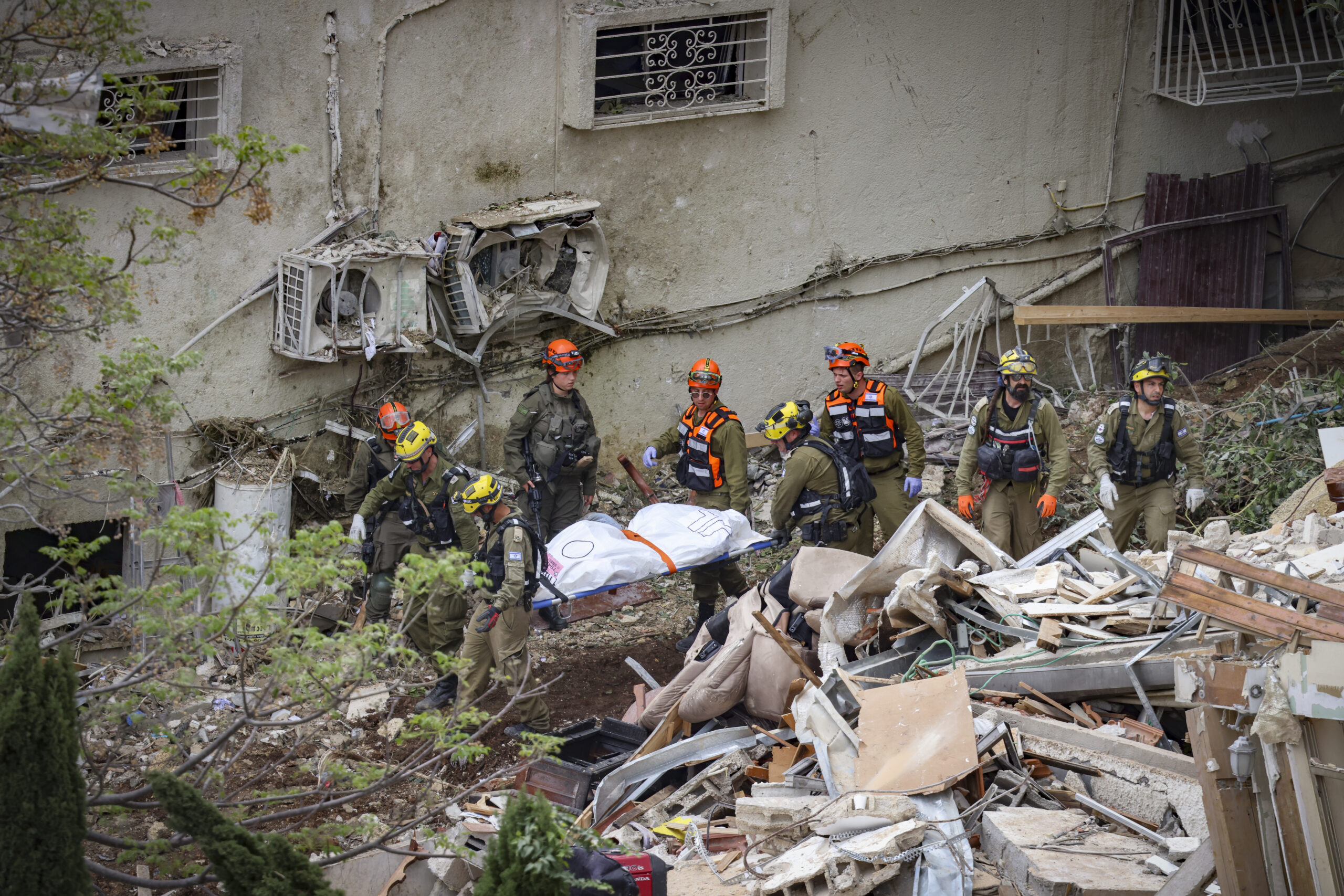
Four members of the same family were killed when an Iranian ballistic missile struck a residential building in Haifa, collapsing multiple floors and trapping them beneath the rubble. Officials said the warhead, which carried hundreds of kilograms of explosives, did not detonate on impact, a fact that prevented far greater destruction and likely saved dozens of additional lives, even as the kinetic force alone proved deadly.
The victims were identified as Vladimir Gershovitz, 73, his wife Lena Ostrovsky Gershovitz, 68, their son Dimitri (“Dima”) Gershovitz, 42, and his wife Lucille-Jane Gershovitz, 30. According to rescue services, the family had no time to reach a protected space before the missile struck Sunday afternoon.
Rescue teams from the Fire and Rescue Service and the Home Front Command initially located two victims, an elderly man and woman, beneath the debris without signs of life. The search continued overnight under dangerous conditions, including concerns that unexploded ordnance remained inside the structure. A senior search and rescue officer said forces “worked slowly and methodically” under the assumption that survivors might still be found.
Investigators determined that the missile’s warhead, carrying several hundred kilograms of explosives, did not detonate on impact. Instead, the kinetic force of the strike caused the building to collapse, pancaking several floors onto the ground level where the victims were located near a stairwell. An Israeli Air Force probe found that the missile was not intercepted after it broke apart mid-air, altering its trajectory.
Had the warhead exploded, officials said, the entire structure and surrounding buildings would likely have been destroyed.
Our hearts ache for the four victims murdered in the Iranian missile strike on Haifa – Vladimir and Lena Gershovich, their son Dmitry, and his partner Lucille-Jane.
— Gideon Sa'ar | גדעון סער (@gidonsaar) April 6, 2026
The four family members were together in their final moments. Two generations of one family were pulled lifeless… pic.twitter.com/2EGIbYc6ze
According to reports, Dimitri and Lucille-Jane had traveled from Herzliya earlier that day to bring Vladimir home from the hospital. Within hours, the missile struck the residence. A family acquaintance said, “Dima managed to bring Vladimir back from the hospital, and, unfortunately, the missile hit the residence, killing the four of them.”
Lena Ostrovsky Gershovitz, a veteran teacher at the Nissan Nativ Acting Studio in Jerusalem, was widely mourned in Israel’s theater community. The Israeli Actors Association said she “nurtured generations of actors with dedication, professionalism, and, foremost, a great love for the work and for her students.” Actress and director Keren Tsur described her as “a mythological teacher,” adding that “there were not many actors in the country who did not know her.”
Medical officials said the attack also left an 82-year-old man seriously wounded. He underwent surgery at Rambam Health Care Campus and remained sedated and ventilated. Additional casualties included a 78-year-old woman moderately wounded, a 38-year-old woman, and a 10-month-old baby who suffered lighter injuries.
The strike on Haifa was part of a broader escalation. In the early hours of Monday, another Iranian missile targeted the same area, this time carrying a cluster warhead that dispersed bomblets across a wide radius. Four people were lightly wounded, including a couple in their 40s and two young girls suffering from smoke inhalation. One submunition ignited a vehicle, while another flipped a car on impact.
FOUR KILLED IN HAIFA
— Mossad Commentary (@MOSSADil) April 6, 2026
Vladimir and Lena Gershevich.
Their son, Dmitry.
And his wife, Lucille-Jean.
A family.
Their bodies were pulled today from the rubble of their home, after an Iranian missile strike last night.
A family. Gone.
Remember their names. pic.twitter.com/bqGtQQgZx7
Central Israel was also targeted with cluster munitions, resulting in at least 15 to 20 separate impact sites. A 34-year-old woman in Petah Tikva was seriously wounded when “fragments” struck near her vehicle. A 90-year-old woman was injured while attempting to reach shelter during the barrage.
Since the war began on February 28, Iran has launched more than 500 ballistic missiles at Israel. At least 14 missiles carrying heavy conventional warheads have struck populated areas, alongside more than 30 incidents involving cluster munitions, creating over 200 distinct impact sites.
Despite early warning systems and widespread compliance with Home Front Command directives, the attack in Haifa underscored a harsh reality. Those who fail to reach a מרחב מוגן (merchav מוגן, protected space) in time remain vulnerable even in a country with some of the most advanced missile defenses in the world.
The deaths of the Gershovitz family were not the result of battlefield engagement. They were civilians in their home, struck by a missile launched from hundreds of kilometers away. Their story is one among many in a war increasingly defined by weapons designed to maximize civilian harm.
The building in Haifa now stands partially collapsed, a concrete reminder of the cost. Four lives from a single family were erased in seconds. The scale of the destruction and the method by which it was carried out, leaves little ambiguity about the nature of the threat Israel is facing.
