


An earthquake sealed it away in 749 CE. Now, 1,300 years later, archaeologists have opened a room that no one has entered since — and what they found inside may rewrite what scholars know about early Christian baptismal rites.
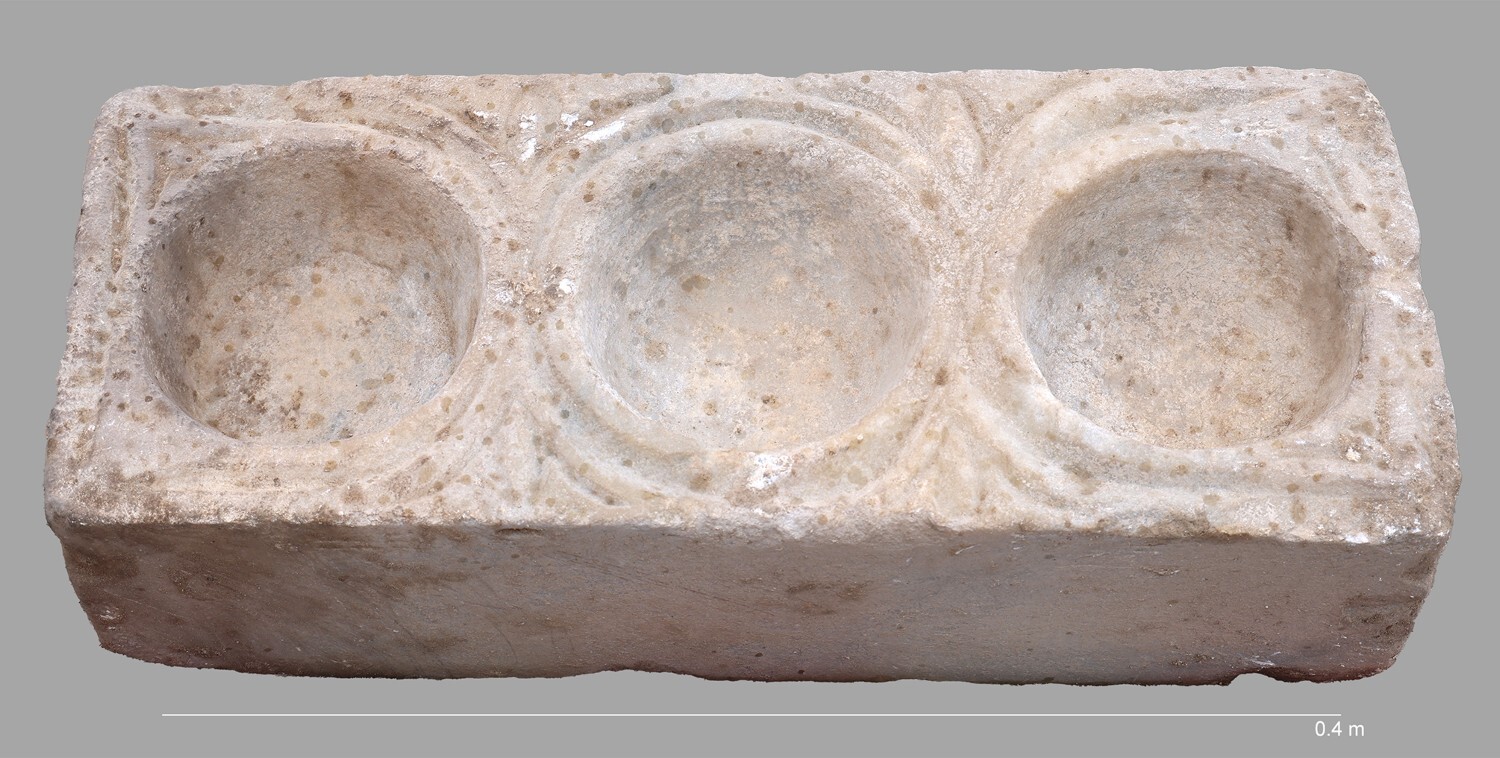
A team from the University of Haifa, led by Michael Eisenberg, co-director of excavations at the ancient city of Hippos (known in Aramaic as Sussita), has uncovered a second baptismal hall — a photisterion, meaning “hall of illumination” — attached to the city’s Byzantine-era cathedral, located on a hilltop 350 meters above the Sea of Galilee. The discovery, published last month in the Palestine Exploration Quarterly, includes a bronze candelabrum, a large marble reliquary, and a marble block with three hemispherical bowls that has no known parallel anywhere in the archaeological record.
The Hebrew Bible describes shemen (oil) as sacred from the earliest pages of Scripture. Jacob poured oil on the stone at Bethel after his dream of the ladder reaching heaven: “And Jacob rose early in the morning, and took the stone that he had put under his head, and set it up for a pillar, and poured oil upon the top of it.” (Genesis 28:18) Oil in the ancient world was not merely practical — it marked encounters with the divine, consecrations, healings, and transitions between states of being. That a three-bowled stone sat beside an early Christian baptismal font, in a room sealed by earthquake for over a millennium, suggests that the Christians of Hippos were doing something with oil during their baptismal ceremonies that no known text fully describes.
“We found it in the perfect position, stuck between the baptismal font and the other liturgical implements,” Eisenberg told the Times of Israel. “It was not there by chance.”
Eisenberg and his co-author Arleta Kowalewska believe the three bowls held different types of oil used in baptismal ceremonies. “We are familiar with similar implements with one bowl or two bowls, but this could be the first one with three bowls,” Eisenberg said. “No parallel has ever been found.”
Robin Jensen, professor emerita at the University of Notre Dame and a specialist in early Christian antiquity, confirmed the artifact’s significance while offering an alternative reading. “Ancient baptismal rituals, both East and West, regularly have two anointings; one preliminary anointing and post-baptismal chrismation… but I don’t know of any triple anointings,” she said. Jensen also raised the possibility that the marble block served as an offering table for food brought to the dead — a practice documented in cemetery contexts. She was emphatic, however, about the quality of the work: “I regard them as very reliable and the overall study of this new photesterion at Hippos very important; their work is careful, and their discovery is significant.”
The find is all the more remarkable because Hippos now stands as the only known early church complex anywhere with two photisteria. The first, excavated in the 1950s, is the largest baptismal hall ever found in Israel — a massive structure with a round-quatrefoil font fed by a conduit of flowing “living water,” large enough for full adult immersion. The newly discovered southern photisterion contains a much smaller font, without entry steps, strongly suggesting it was used for infant baptism. “The bishop and the cathedral were the only ones performing baptisms, not only in Hippos but in the whole region,” Eisenberg said. “They had a monopoly.”
Hippos occupied a singular position in the early Christian geography of the region. It was the only Christian city on the eastern shore of the Sea of Galilee — the lake so central to the ministry of Jesus — visible from great distances, perched on its mountain above the water. At its height, the city contained at least seven churches within its walls, all built between the fifth and early sixth centuries CE and continuing to function even after the Muslim conquest of 636 CE. Hippos did not fall to conquest. It fell to administrative erasure: when the new Islamic rulers moved the regional capital across the water to Tiberias (Ṭabariya), Hippos slowly emptied. By the time the earthquake struck in 749 CE, the city was already a shell of itself.
The sealed reliquary found beside the baptismal font was empty when archaeologists opened it in the field. Eisenberg believes the relics — likely connected to Cosmas and Damianus, the third-century physician-martyrs to whom the cathedral was dedicated — were deliberately removed by Christians before they abandoned the city. “When Christian believers left a place, holy relics were the first thing they brought with them,” he said.
What the departing Christians left behind — an unremarkable marble block with three bowls — may tell us more about the living faith of a Byzantine Christian community than the relics themselves ever could. Early Christianity was not monolithic. Ceremonies varied by region, by bishop, by local tradition. “This opens up many questions about local or regional customs for ceremonies and how much we do not know about them,” Eisenberg said.


