


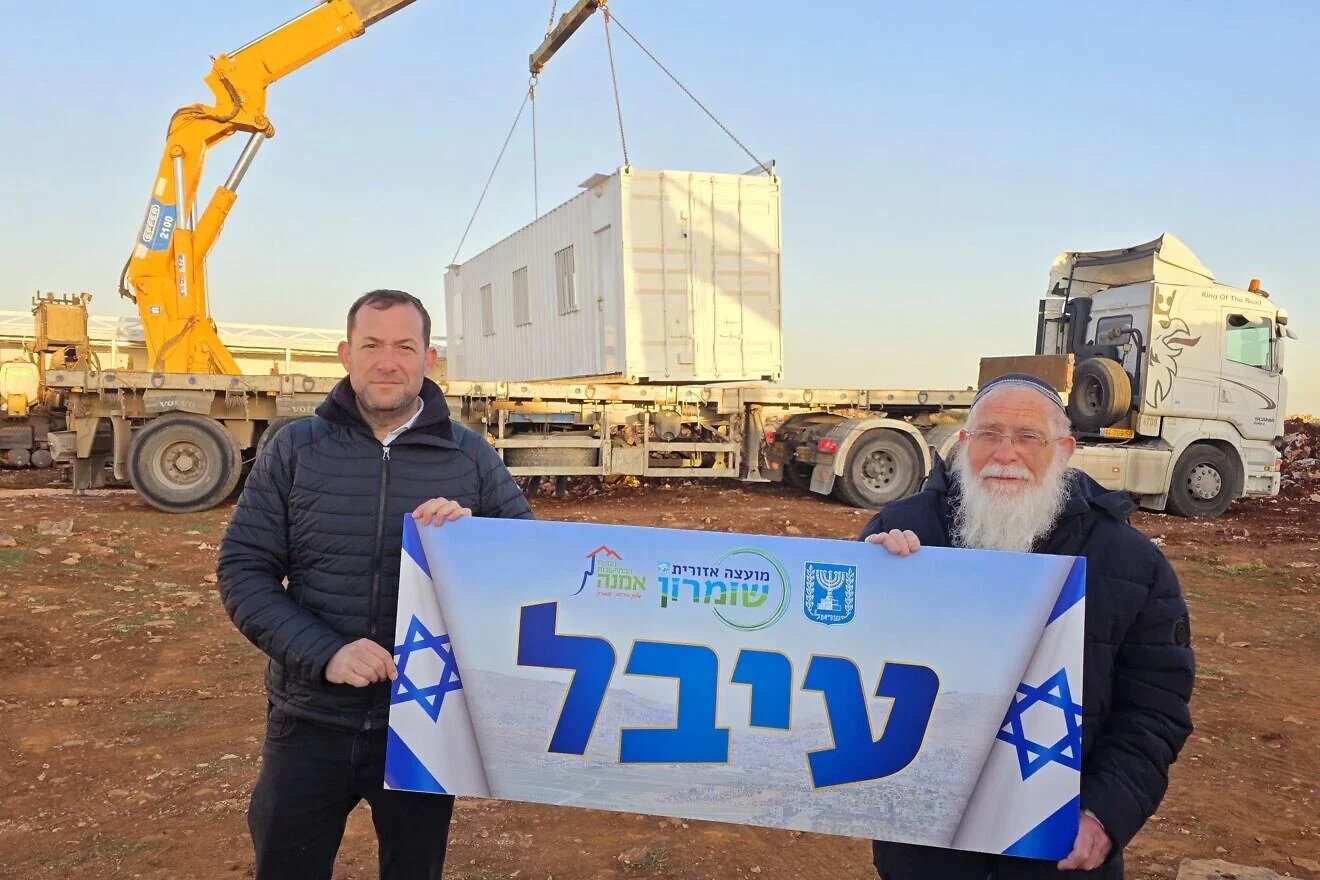
The first Jewish homes have been erected on Mount Ebal, marking the beginning of a new community at one of the most historically and biblically significant sites in Judea and Samaria. The move comes nearly a year after the Israeli Cabinet approved the establishment of the town and follows formal Interior Ministry authorization last month.
Workers from the Samaria Regional Council and the Amana settlement movement erected the initial residential structures overnight on Wednesday. The site lies adjacent to the location widely identified by archaeologists as the altar built by Joshua after the Israelites entered the Land of Israel.
Samaria Regional Council head Yossi Dagan described the moment as a continuation of the biblical story of the Jewish people in the land.
“This morning, we’re privileged to feel the wings of history beating,” Dagan said at the site. “To make history together here by establishing a new community this morning on the heights of Mount Ebal—next to the location where Joshua built an altar and where the people of Israel became a nation.”
Mount Ebal appears in the Book of Joshua as the location where the Israelites renewed their covenant with God shortly after entering the Land of Israel. Joshua built an altar there and inscribed the words of the Bible onto stones, creating a national moment of covenantal affirmation.
“Then Joshua built an altar to the Lord, the God of Israel, on Mount Ebal” (Joshua 8:30).
The ceremony described in the Bible divided the tribes between Mount Ebal and Mount Gerizim. From those mountains, the blessings and curses of the covenant were proclaimed, marking the first national gathering of the Israelites in the land. Mount Ebal therefore, represents not merely a geographical location but a foundational moment in the creation of the Jewish nation.
Dagan said the decision to establish the community was also motivated by efforts to safeguard the nearby archaeological site identified with Joshua’s altar.
“The establishment of the village near Joshua’s Altar comes in response to attempts by the Palestinian Authority to damage and destroy the Jewish heritage site,” he said.
The first residents are expected to establish an agricultural yeshivah—a Torah academy—affiliated with the Alon Moreh hesder yeshivah, a program combining advanced Torah study with military service. Additional families are expected to join in the coming months as founding residents of the town.
During Wednesday’s ceremony, Dagan and Samaria Rabbi Elyakim Levanon recited the traditional blessing Matziv Gvul Almanah, meaning “Blessed is He who establishes the boundary of the widow.” The blessing is traditionally recited when Jewish settlement is renewed in the Land of Israel.
“Today is a great day for the people of Israel,” Levanon said. “Here we are, continuing the path of our forefather Abraham. Thousands of years have passed since then, and thank God we continue his path.”
“With God’s help, just as he was the foundation of the people of Israel, so too this place will become a foundation for many more communities—a great revival of the people of Israel, a great salvation, and may we soon see complete redemption in our days,” he added.
The Israeli Security Cabinet approved the establishment of 22 Jewish communities across Judea and Samaria in May 2025, including the new town on Mount Ebal. Some of the communities legalized previously existing outposts, while others, like the Mount Ebal project, represent entirely new communities.
Archaeology has added another layer of significance to the mountain. In the 1980s, Israeli archaeologist Adam Zertal discovered a large rectangular structure on Mount Ebal dating to the 13th century BCE, the early Iron Age. The structure includes a ramp rather than steps and contained large quantities of animal bones from sacrificial species. The features closely match the biblical description of an altar used for offerings.
More recently, researchers analyzing material recovered through wet sifting at the site identified a small folded lead tablet bearing what they believe is a proto-Hebrew inscription. The inscription includes a curse formula invoking the divine name YHVH, which researchers say may represent one of the earliest Hebrew inscriptions ever discovered.
The new homes now standing on Mount Ebal place Jewish life once again beside the location where, according to the Bible, the Israelites first publicly affirmed their covenant with God in the Land of Israel. For supporters of the project, the establishment of a community at the site represents the continuation of a story that began more than three thousand years ago.
