




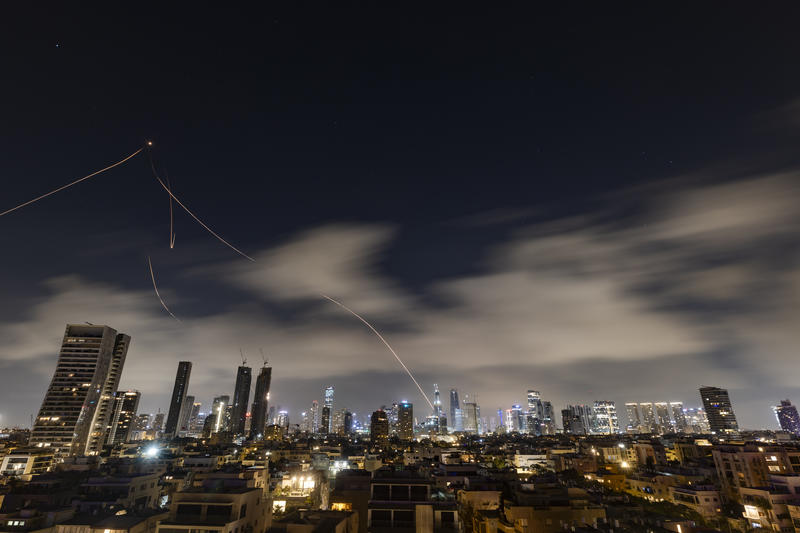
The skies over Israel turned into a battlefield again on Saturday as Iran launched six missile salvos targeting communities from Eilat in the south to the Jerusalem area in the center and north. A 12-year-old boy lay bleeding in Eilat’s Yoseftal Medical Center, struck by shrapnel from a cluster bomb — the kind of weapon designed not just to kill once, but to scatter death across a wide area.
Another video shows one of the impacts, likely a cluster bomb munition from the Iranian missile, in Eilat a short while ago. pic.twitter.com/KbrnGrKlVk
— Emanuel (Mannie) Fabian (@manniefabian) March 14, 2026
Iran’s Saturday assault struck most of the Jewish state, with submunitions from cluster warheads hitting at least three sites in Eilat, damaging roads and wounding three people — including two children. The hospital treated six more for acute anxiety. In central Israel, cities like Lod and Ness Ziona absorbed further cluster munition impacts, with damage to property but no casualties. Overnight attacks continued, with two elderly residents of Holon — both 80 years old — wounded by shrapnel and smoke inhalation, respectively, when rockets struck the Tel Aviv suburb early Sunday.
Footage shows an impact, possibly a cluster bomb munition from an Iranian missile, in central Israel a short while ago.
— Emanuel (Mannie) Fabian (@manniefabian) March 14, 2026
A number of impact sites in central Israel were reported, with no injuries. pic.twitter.com/GAkKd4C6nL
Israel’s Health Ministry reported that since Operation Roaring Lion began on February 28, 3,195 people have been evacuated to hospitals. As of Sunday morning, 81 remain hospitalized — one in critical condition.
While Iranians were firing at Israeli children, the IDF was dismantling Iran’s war machine. In a single 24-hour stretch, Israeli jets struck over 200 targets in Iran’s west and center — dozens of ballistic missile launchers, air defense systems, weapons storage sites, and missile launch infrastructure. Two senior Iranian intelligence officers, Abdollah Jalali-Nasab and Amir Shariat — who had been promoted after their predecessor was killed in the war’s opening strikes — were eliminated in a strike on a Tehran facility belonging to Iran’s military emergency command, the Khatam-al Anbiya Central Headquarters. Israel also struck Iran’s primary space research center, which the IDF said housed laboratories developing military satellites used for surveillance and targeting across the Middle East. A central factory producing air defense systems was destroyed as well.
Iranian Space Research Center (ISRC) was bombed tonight. The center is responsible for various space activities of Iran including development of satellites, space propulsion and tests of space components. pic.twitter.com/Sq7qjvSRiw
— Tal Inbar (@inbarspace) March 13, 2026
Defense Minister Israel Katz said the war was “escalating” and entering a “decisive stretch that will continue as long as necessary.” He added that only the Iranian people themselves could bring it to an end — by rising up against their regime.
An Israeli Air Force pilot narrowly avoided being shot down over Iran. The IDF confirmed an interception attempt that came dangerously close to success, crediting the pilot’s alertness and professionalism for preventing the aircraft’s loss. The mission, the military said, was completed successfully.
On the home front, Israelis received modest but meaningful relief. The IDF’s Home Front Command eased wartime restrictions in several lower-threat regions — including the Beit She’an Valley, Jordan Valley, Judea, Samaria, the Dead Sea area, the Gaza border communities, and the Arava — moving them from “limited activity” to “partial activity” beginning Monday at 6 a.m. Schools will be permitted to reopen in those areas, provided adequate bomb shelters are accessible.
The Home Front Command also announced improvements to its missile warning system. Currently, early alerts are sent to a wide area shortly after a launch from Iran is detected, before the missile’s trajectory is fully known. Sirens then sound in a more targeted zone. Going forward, the Command said it has refined the system to issue preliminary alerts in smaller areas, aiming to reduce the number of civilians who receive an early warning but ultimately face no sirens by 30 to 50 percent.
Iran has fired hundreds of projectiles at Israel since this war began. Fourteen civilians are dead. Nearly 2,800 have been wounded. The regime in Tehran chose this war. The Jewish state will see it through — and the world is watching which side buries its soldiers and which side dismantles its enemies.

