



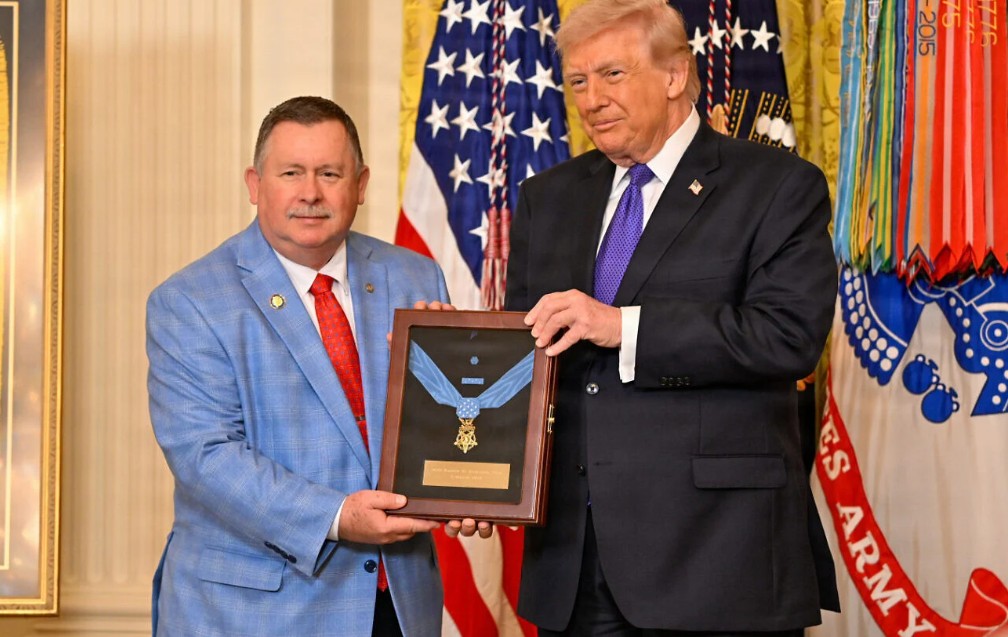
On the morning of January 27, 1945, a Nazi commandant pressed a pistol against the forehead of Master Sergeant Roddie Edmonds, a Tennessee soldier, and demanded he betray his Jewish comrades. “We are all Jews here,” Edmonds said, saving 200 Jewish soldiers while risking near-certain death. In recognition of his bravery, President Trump placed the Medal of Honor — America’s highest military decoration — in the hands of Edmonds’ son, Chris, in a ceremony at the White House East Room on March 2.
Edmonds, born August 20, 1919, in Knoxville, Tennessee, enlisted in the U.S. Army in March 1941. He arrived in the European Theater in December 1944 with the 106th Infantry Division — just five days before Germany launched the Battle of the Bulge. On December 19, 1944, he was captured and sent first to Stalag IX-B in Bad Orb, Germany, where Jewish POWs were already being segregated into lice-infested barracks on starvation rations. He was then transferred to Stalag IX-A in Ziegenhain, where, as the highest-ranking non-commissioned officer among 1,275 American prisoners, command fell to him.
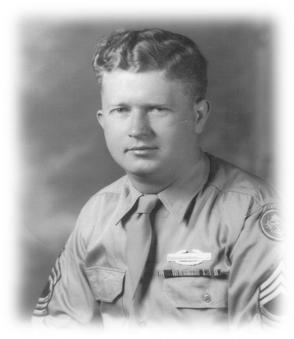
On the evening of January 26, 1945, the German captors made their announcement: only Jewish-American prisoners were to fall out for roll call the following morning. Those who failed to comply would be executed. Edmonds understood immediately what this meant. The Germans were murdering Jewish POWs on the Eastern Front. Segregation in Stalag IX-A would be a death sentence for the more than 200 Jewish soldiers under his command.
He ordered all 1,275 Americans to assemble.
When the Nazi commandant arrived the next morning and saw the entire camp standing in formation, he was furious. He called Edmonds forward, pressed his pistol against his forehead, and demanded that the Jewish soldiers step out. Edmonds told him, “We are all Jews here.” He then warned the commandant that if he fired, he would face war crimes prosecution after the war, since under the Geneva Convention, prisoners were required to give only name, rank, and serial number. Religion was not required.
The commandant lowered his weapon and walked away.
Jewish POW Paul Stern, who had been captured during the Battle of the Bulge and had survived the forced march in bitter cold that killed some of his fellow prisoners along the way, was standing near Edmonds during the exchange. He told Yad Vashem: “Although seventy years have passed, I can still hear the words he said to the German camp commander.”
Lester Tanner, another Jewish POW who had served under Edmonds and was present that morning, described what it meant in stark terms: “There was no question in my mind or that of M/Sgt Edmonds that the Germans were removing the Jewish prisoners from the general prisoner population at great risk to their survival.” Tanner recalled Edmonds from his training days as a man who “did not throw his rank around” but who “knew his stuff” — a soldier his men trusted completely.
Edmonds’ resistance did not end that January morning. Months later, as Allied forces advanced and the Germans ordered the evacuation of the camp — moving prisoners further east — Edmonds, armed with a stolen radio to monitor news reports, ordered all American POWs not to cooperate. He instructed senior non-coms to form the men up in front of the barracks and, when the transports arrived, he would give the order to break ranks and rush back inside. He repeated these defiant actions for hours, and then ordered the men to hide, or even eat grass or dirt, to delay and confuse their captors. Despite threats of execution and attacks from guard dogs, the Nazi commandant eventually announced that the Americans could have the camp. Twenty-four hours later, soldiers from the U.S. Army’s 3rd Army arrived.
After the war, Edmonds came home. He never mentioned any of it — not to his wife, not to his children. He was recruited again during the Korean War, served with the 1st Cavalry Division, and afterward worked for The Knoxville Journal and in sales. He died on August 8, 1985, without any official recognition for what he had done.
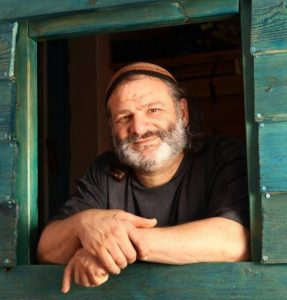
His son Chris, a Baptist minister, discovered the story only after his father’s death, reading through diaries Edmonds had kept in the camp. He then spent years tracking down surviving witnesses, gathering testimony for Yad Vashem. Among those Edmonds had saved was Sonny Fox, who went on to become a well-known American television host.
On February 10, 2015, Yad Vashem recognized Roddie Edmonds as Chassid Umot HaOlam — Righteous Among the Nations — Israel’s highest honor for non-Jews who risked their lives to save Jews during the Holocaust. He remains the only American serviceman ever to receive this distinction. The award ceremony was held at the Israeli Embassy in Washington on January 27, 2016, where Israeli Ambassador Ron Dermer and Yad Vashem Council Chairman Rabbi Lau presented the medal and certificate of honor to Chris Edmonds. Then-President Barack Obama attended and praised Edmonds’ actions as “above and beyond the call of duty.”
It took another decade — and a change of administrations — before the Medal of Honor followed. President Trump had notified Chris Edmonds of the award on February 16, 2026. At the White House ceremony on March 2, Trump recounted Edmonds’ words to the commandant and said simply: “Really amazing, right? It’s an amazing story.” Two other service members were also honored that day: retired Command Sgt. Maj. Terry P. Richardson, recognized for actions during Vietnam that saved 85 lives, and Staff Sgt. Michael H. Ollis, killed in Afghanistan in 2013 while shielding a Polish Army officer from enemy fire.

