


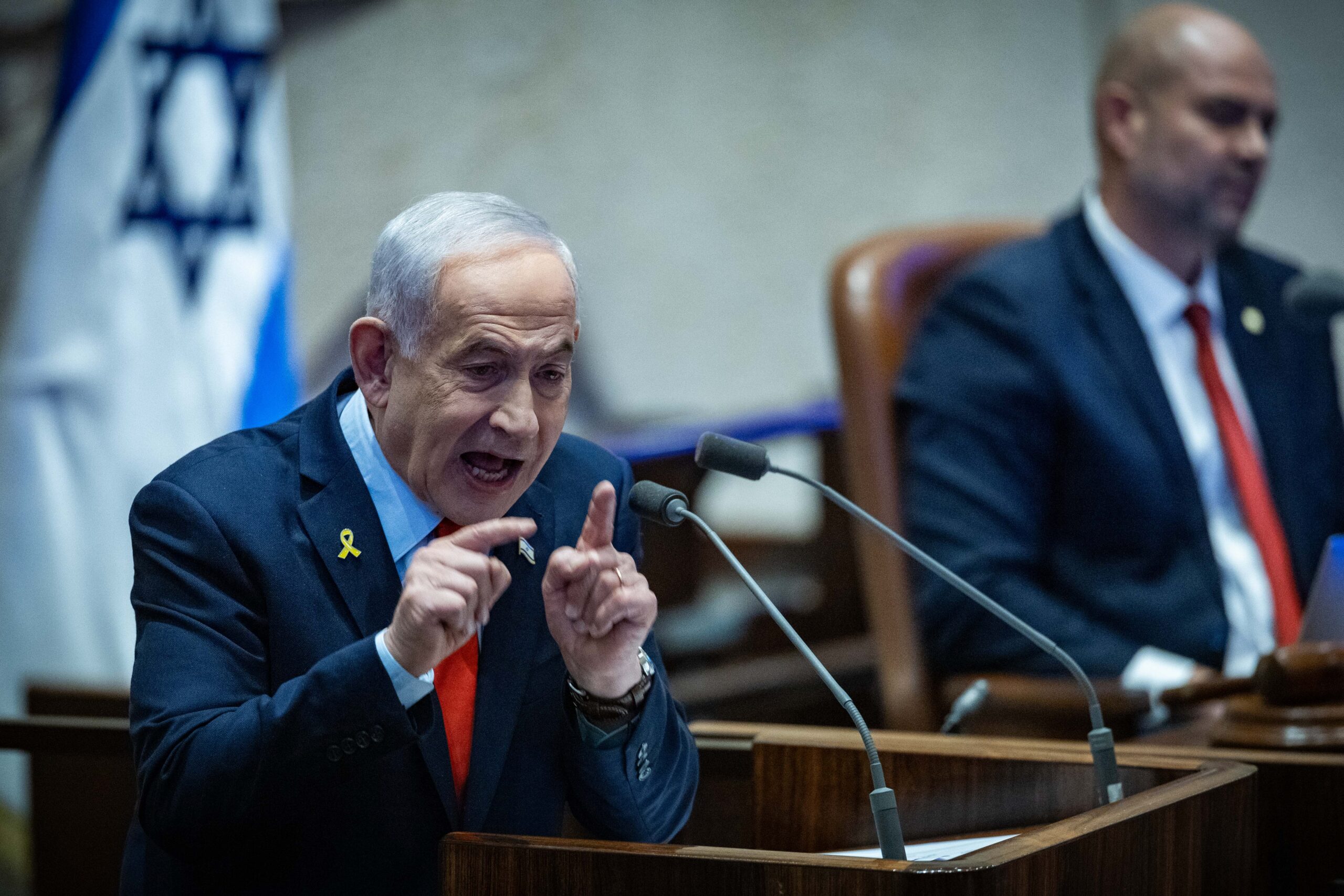
Netanyahu Circulates Report Claiming Bennett-Era Funds Backed Anti-Israel Initiatives
Prime Minister Benjamin Netanyahu on Wednesday drew public attention to an investigative report alleging that funds distributed under former Prime Minister Naftali Bennett’s coalition government reached Arab initiatives that promoted narratives rejecting Israel’s legitimacy as a Jewish state.
Netanyahu shared a short clip from a Radio 103FM morning broadcast featuring commentators Ben Caspit and Yinon Magal. In the segment, Magal referenced a report by the Hebrew-language outlet HaKol HaYehudi, claiming that an NGO funded during Bennett’s tenure supported programming that raised awareness of the Palestinian “right of return” to villages destroyed during the 1948 War of Independence.
According to the report, funding flowed through a five-year socioeconomic development framework known as the Takadum (“Progress”) plan. The plan, approved in October 2021 by the Bennett-Lapid government and supported by the United Arab List (Ra’am), aimed to reduce economic disparities within Arab Israeli society.
The investigation alleges that some programs operating under the plan strengthened Palestinian national identity among Arab youth. Central to the report is the Midad NGO, described officially as promoting civic engagement among young Arab Israelis. The organization reportedly received funding from Israel’s Welfare and Social Affairs Ministry and the National Insurance Institute.
The investigation claims that initiatives connected to Midad included walking tours highlighting Palestinian landmarks in Jerusalem, engagement with a pro-Palestinian student group at Hebrew University, and collaboration with INJAZ Palestine, which produces content critical of Israeli policies in Jerusalem.
The report also cited educational visits to former Arab villages such as Damun and Al-Khalisa, locations many Palestinians associate with the right-of-return narrative. It further alleged that program materials directed participants to activities developed by Baladna, a youth organization affiliated with the Balad political party.
Additional claims referenced activities with the Yabous Cultural Centre in eastern Jerusalem, which was raided by Israel Police on Jan. 22, 2026, after screening a film authorities described as pro-terrorism.
Netanyahu commented publicly on the investigation, questioning how public funds were used during the Bennett-Abbas partnership.
Separately, scrutiny has fallen on organizations linked to Ra’am. In 2024, Israel’s Justice Ministry reported evidence suggesting that entities associated with the party had transferred funds or cooperated with groups designated abroad as terrorist organizations. A February 2024 report stated that Igatha 48, identified as a fundraising arm of the Southern Branch of the Islamic Movement in Israel, transferred more than $120,000 between 2020 and 2023 to a Turkish organization called Khir Ummah, described in the report as a Hamas front group.
In April 2024, the Tel Aviv District Court rejected Igatha 48’s request to unfreeze accounts at Bank Leumi, after the bank cited significant compliance concerns. During proceedings, the organization acknowledged that multiple financial institutions had declined to open accounts for it.
NYC Council Holds Marathon Hearing Over Proposed Synagogue ‘Buffer Zone’ Law
A New York City Council hearing intended to address rising antisemitism turned into a nearly 10-hour debate over free speech, public safety and constitutional boundaries.
The Council’s Committee to Combat Hate examined a package of seven bills, with the most contentious proposal establishing buffer zones outside houses of worship and schools. Supporters say the measure would prevent harassment and intimidation. Critics warn it could infringe on First Amendment rights.
Councilmember Julie Menin initially proposed a 100-foot fixed boundary between protesters and religious institutions. Following objections, lawmakers revised the draft to remove a specific distance. The updated language allows the New York Police Department to determine buffer size based on each location and situation.
Michael Gerber, the NYPD’s deputy commissioner for legal matters, testified that restrictions must remain flexible and circumstance-driven. He emphasized that protesters retain the right to be seen and heard, even when their speech is offensive. However, he clarified that individuals who enter a designated “frozen zone” could face arrest if they obstruct access.
The legislation follows several recent confrontations outside Jewish institutions.
In November, protesters gathered outside Park East Synagogue during a pro-aliyah event organized by Nefesh B’Nefesh (aliyah being the term referring to the process of Jews moving to Israel). According to video footage circulated by Israel’s consulate in New York, demonstrators used loud horns, shone lights at attendees, and shouted hostile slogans as worshippers attempted to enter and exit.
At the hearing, Bennett Katz testified that masked protesters surrounded him that evening and that one individual threw a punch that grazed his shoulder as he approached the synagogue wearing a kippah.
Gerber acknowledged police missteps during that protest, stating that an appropriate buffer was not established at the synagogue entrance and that internal guidance was revised afterward.
Additional incidents included demonstrations outside the 92nd Street Y during a public conversation featuring columnist Bret Stephens and Rabbi David Ingber, as well as a January protest outside Yeshiva of Central Queens in which demonstrators reportedly shouted pro-Hamas slogans.
Supporters of the bill argue that religious freedom requires meaningful access protections. Mark Treyger, CEO of the Jewish Community Relations Council of New York, said no person should feel threatened while entering a house of worship. He distinguished between general protest activity and targeting individuals at the doors of religious institutions.
Opponents, including representatives of the New York Civil Liberties Union, cautioned that expanding buffer authority could erode constitutional protections.
The Council continues to deliberate how to balance public safety, religious freedom, and the right to protest.
IDF Targets Hezbollah infrastructure in Lebanon’s Bekaa Valley
The Israel Defense Forces announced Thursday that it struck Hezbollah infrastructure in the Baalbek region of Lebanon’s Bekaa Valley.
According to the IDF, the operation targeted facilities used by Hezbollah’s Radwan Force, an elite unit that Israeli officials say trained for a large-scale ground incursion into northern Israel under a plan referred to as the “Galilee invasion.” Israeli authorities have previously stated that Hamas modeled aspects of its Oct. 7, 2023, cross-border attack on similar operational concepts.
In a follow-up statement, the IDF reported striking eight compounds allegedly used to store weapons, train operatives, and plan attacks against Israeli forces and civilians.
The military said Hezbollah’s rearmament efforts violate the ceasefire understandings reached between Israel and Lebanon in November 2024, following months of cross-border hostilities that began after Hezbollah joined Hamas’s war against Israel on Oct. 8, 2023.
Reuters reported this week that Israeli officials conveyed warnings to Lebanese intermediaries indicating that broader strikes, potentially including civilian infrastructure such as Beirut’s international airport, could follow if Hezbollah becomes involved in a direct conflict between the United States and Iran.
Lebanon’s government has publicly committed to disarming Hezbollah under the terms of the U.S.-brokered ceasefire. However, regional media outlets have reported that Hezbollah recently intensified internal military coordination.
Separately, the IDF stated Wednesday that Israeli troops operating in southern Lebanon have located and dismantled Hezbollah weapons stockpiles, observation posts, and firing positions in recent months. Israeli officials say these actions aim to prevent renewed military buildup along the northern border.

