



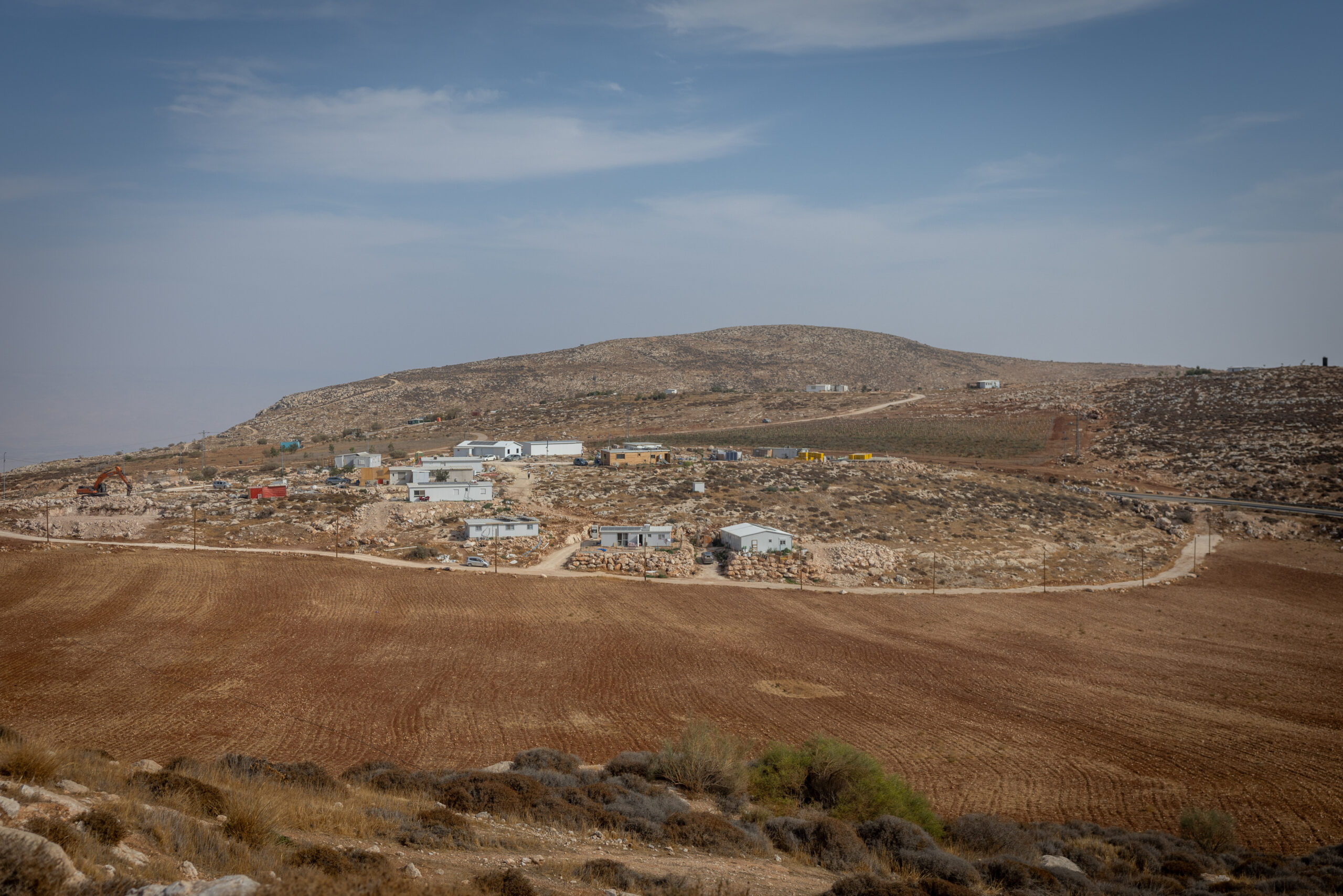
A recent development agreement signed between the state and the Mateh Binyamin Regional Council would, pending final approvals, establish a new Jewish community that, in practical terms, constitutes the first expansion of Jerusalem since 1967. The plan calls for the construction of approximately 2,780 housing units in what is officially described as a new “neighborhood” of Adam, a community located just northeast of Jerusalem’s municipal boundary.
The project would be built on roughly 500 dunams of land between the Arab towns of Hizma and Al-Ram. The government has committed approximately NIS 120 million for infrastructure, public spaces, and community institutions. Although the development is technically considered a westward extension of Adam, it is physically separated from that town by Route 437 and the security barrier. In practice, it has far greater territorial contiguity with the Jerusalem neighborhood of Neve Yaakov, which lies inside the capital’s municipal borders.
The plan has not yet been submitted to the Civil Administration’s Higher Planning Committee, meaning that statutory authorization could take up to 2 years. Nevertheless, the Housing Ministry has already marketed 500 housing units for the first phase.
In a February 3 statement, the Housing and Construction Ministry said: “The agreement constitutes a significant step in continuing the development of the settlement and strengthening the settlement continuity in the area, while providing a response to the demand for housing in and around Jerusalem, and integrating a phased and balanced planning of new neighborhoods alongside the existing fabric.”
The Peace Now organization condemned the move, asserting that it constitutes “the first time since 1967 that Jerusalem has been expanded” beyond the Green Line. “Under the pretext of a new settlement, the government is carrying out a backdoor annexation here,” the group said. “The new settlement will function for all intents and purposes as a neighborhood of the city of Jerusalem.”
It should be noted that the so‑called Green Line is not an “official border,” but the 1949 armistice demarcation lines agreed upon after the War of Independence, marking where armed forces halted fighting. These armistice agreements, including the one with Jordan, explicitly state that the lines were drawn for military considerations and “are agreed upon by the Parties without prejudice to future territorial settlements or boundary lines or to claims of either Party relating thereto,” and that they “are not to be construed…as a political or territorial boundary.” This means they were never intended to define permanent sovereign borders. In practice, since there was no peace treaty, the line became a de facto reference point, but it has no legal status as a border for Israel or for any prospective Palestinian state and is explicitly a ceasefire line set solely to end hostilities.
MK Gilad Kariv, an extreme leftist member of the Democrats party, described the plan as “another unprecedented act of annexation,” warning that “annexation will bring about a security catastrophe.”
By contrast, Mateh Binyamin Regional Council head Israel Ganz called the agreement “the realization of the settlement vision,” stating that it would allow the construction of thousands of housing units while upgrading the quality of life for residents.
Since Israel reunited Jerusalem in 1967, every Jewish neighborhood built in the eastern part of the city has been constructed within the expanded municipal boundaries established after the war. This project is different. While not formally annexed, it creates a new Jewish continuum directly adjacent to Jerusalem and reinforces Israeli presence in the strategic corridor north of the capital.
This expansion of Jerusalem could mark the fulfillment of explicit Biblical prophecies that Jerusalem will one day grow far beyond its current borders. The prophet declared: “Jerusalem shall be inhabited without walls because of the multitude of people and cattle therein. For I, says Hashem, will be unto her a wall of fire round about, and I will be the glory in her midst” (Zechariah 2:8–9).
The verse is explicit. Jerusalem will overflow its boundaries. Its growth will make walls obsolete. The Sages understood this not as poetry but as a description of the future.
In tractate Sukkah 41b of the Babylonian Talmud, the discussion of the future Temple presumes a transformed and expanded Jerusalem. The Midrash in Pesikta Rabbati 31 teaches that in the future, Jerusalem will spread over the entire Land of Israel. The Sages state plainly that the city will not remain confined to its current measurements.
The vision of the future Temple in the Book of Ezekiel, chapters 40–48, describes dimensions vastly exceeding those of the First and Second Temples. The sacred precinct alone dwarfs previous boundaries. This is not symbolic language detached from geography. It is a blueprint for a Jerusalem of a different scale in the era of the Third Temple.
The prophet Isaiah commands: “Enlarge the place of your tent, and let them stretch forth the curtains of your habitations; spare not, lengthen your cords, and strengthen your stakes” (Isaiah 54:2). The Sages applied this to Jerusalem in the days of geulah—redemption. Expansion is not incidental. It is commanded.
This stands in direct contrast to the 1947 UN Partition Plan advanced by the United Nations, which proposed an internationalized Jerusalem stripped of Jewish sovereignty. The two-state paradigm continues that framework, envisioning an exclusively Muslom Palestinian Jerusalem, severed from its Biblical heart and reduced to a diplomatic bargaining chip. That model attempts to freeze the city or divide it. The prophets describe the opposite: a Jerusalem that expands, absorbs, and radiates outward.
The current development plan north of Jerusalem does not invoke prophecy in its language. It speaks of infrastructure, continuity, and housing demand. Yet the practical effect is unmistakable. Jewish Jerusalem is pushing outward for the first time in nearly six decades.
Jerusalem has never been static. From the City of David to the expansion under King Hezekiah in the eighth century BCE, from the return under Ezra in the fifth century BCE to the Hasmonean and Herodian enlargements, growth has defined the city in every era of Jewish sovereignty. Constriction and division have marked foreign rule.
The prophets describe a future in which Jerusalem becomes the world’s gravitational center and the site of the Third Temple. The Sages teach that it will not remain within its present lines. The new development north of the capital is a fact on the ground. It strengthens Jewish continuity around Jerusalem and signals that the city’s growth has resumed.
Jerusalem will not be erased. It will not be internationalized. It will not be partitioned out of its Biblical identity. The Bible describes a city that expands beyond walls, beyond limits, beyond the cramped frameworks imposed in 1947. That future begins with concrete, roads, and families building homes on the hills surrounding the eternal capital.
