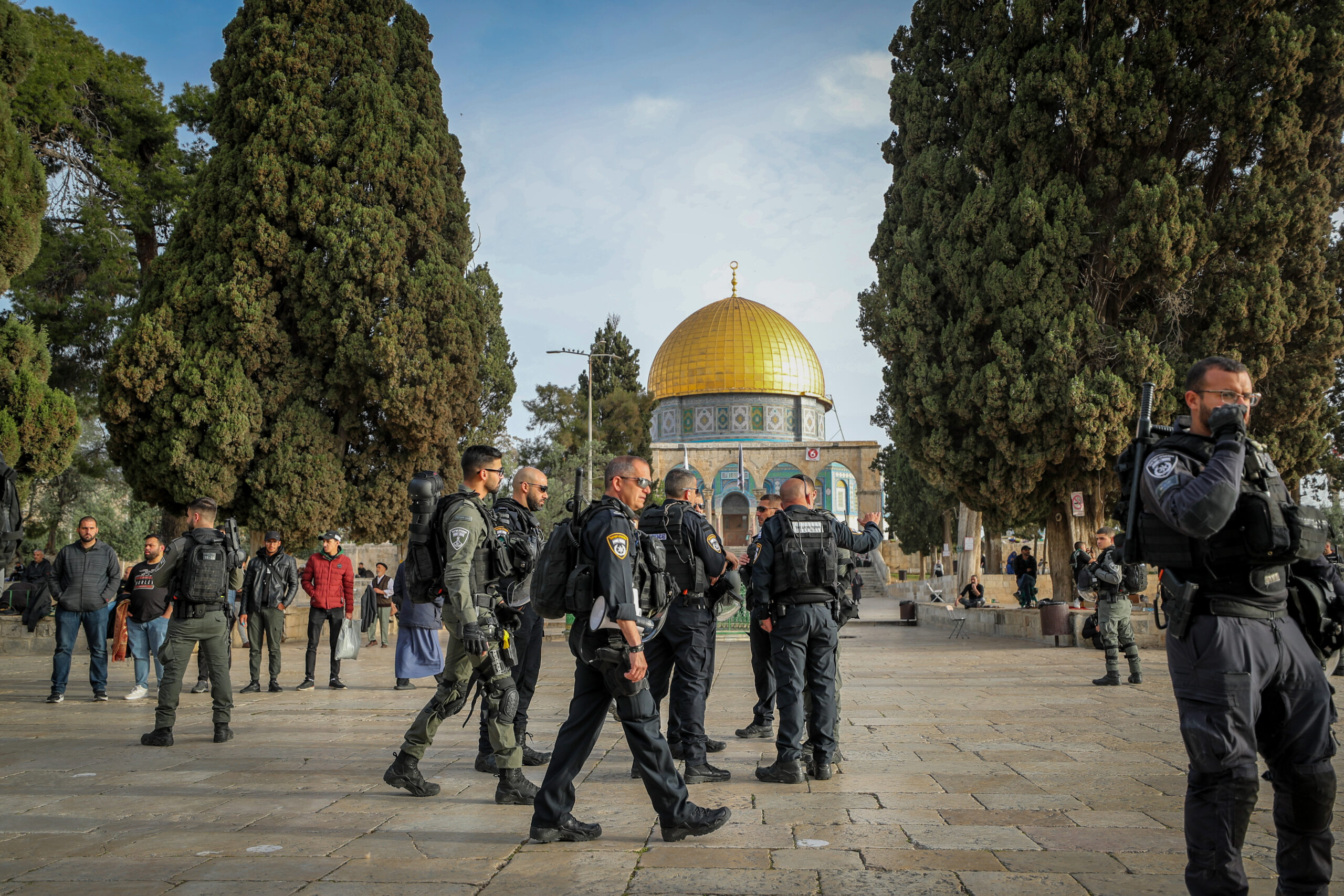
Israeli authorities announced a significant restriction on Jewish access to the Temple Mount during the Muslim holy month of Ramadan, closing the site to non-Muslim visitors during the afternoon hours when Jews traditionally pray Mincha (the afternoon prayer). While the Israel Police extended morning visiting hours from 6:30 a.m. to 11:30 a.m.—a five-hour window—this represents a trade-off rather than expanded access, as the Mount will be entirely closed to Jews in the afternoon throughout the month, which runs from this week through March 19th.
The policy shift comes as security forces prepare for what officials assess as a heightened potential for friction, despite relatively few major attacks in recent months. Israeli security is bracing for possible Iranian-orchestrated violence, increased stone-throwing incidents, and attempts by Palestinians to infiltrate into Israeli territory to reach the Temple Mount.
When King Solomon dedicated the First Temple, he declared: “My house shall be called a house of prayer for all peoples” (Isaiah 56:7). This verse establishes the universal nature of the site while affirming Jewish sovereignty over it. The Temple Mount belongs to the Jewish people by divine mandate and historical right, yet for decades, Israeli authorities have restricted Jewish prayer there under a discriminatory arrangement falsely labeled the “status quo.”
Israeli law mandates equality and freedom of religion for all faiths, as per a Supreme Court ruling in 2014 that Jews have the right to pray on the Temple Mount. The ruling added that the police may curtail these freedoms for security reasons. This legal framework has created a situation where the threat of Muslim violence effectively determines Jewish religious rights at Judaism’s holiest site.
The restrictions extend beyond Jews. Christians visiting the Temple Mount are prohibited from bringing Christian Bibles, Psalms, or prayer books to the site and face similar restrictions on their hours of visitation, demonstrating that Muslim exclusive claims trump the religious freedoms of all other faiths.
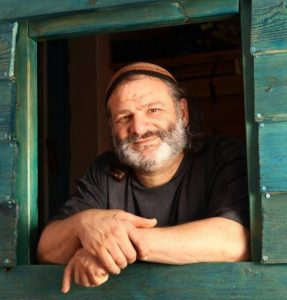
Knesset Member Amit Halevi, a descendant of the tribe of Levi—whose ancestors were tasked with serving, guarding, and gatekeeping the Temple—visited the Temple Mount Sunday morning and delivered a sharp rebuke to the decision restricting Jewish access during Ramadan’s midday hours.
“There must not be even a comma of change to Jewish prayers on the Temple Mount during the month of Ramadan,” Halevi declared after morning prayers alongside Rabbi Shimshon Elbaum, head of the Temple Mount Administration. “Anyone who comes here to pray, and anyone who leads the prayers on behalf of the Muslim community, must decide whether Ramadan is a month of charity and prayer—or of barbaric terror and evil.”
Following the decision to restrict Jewish access to the Temple Mount at midday during Ramadan, Likud MK Amit Halevi visited the site and said, “There should be no change to Jewish prayers on the Temple Mount during Ramadan.” He added he would raise the issue with the Prime… pic.twitter.com/lW0BT2W3V8
— General Quacker | الجنرال كواكر (@general_he42676) February 15, 2026
Halevi emphasized the absurdity of restricting Jewish worship at the site that belongs to the Jewish people. “The notion that we will accept a reality in which someone comes here to pray, and no one can pray alongside him—certainly not the Jews, the legal owners of this place—is intolerable and unacceptable.”
The Knesset member announced his intention to appeal directly to Prime Minister Benjamin Netanyahu and National Security Minister Itamar Ben Gvir to maintain current prayer arrangements. “I will demand that this must at least remain as it is, and that Jews will continue to pray here. ‘My house shall be called a house of prayer for all peoples,’ and if others wish to pray, they may pray. Under no circumstances should Jewish prayers be reduced by even a comma this month.”
During his visit, Halevi noted encouraging developments on the ground. For the first time, he used prayer sheets and siddurim (prayer books) distributed to Jewish worshippers at the site. “That is the direction we need to go; to pray for justice, for truth, and for peace. The peace of the entire world,” he said.
The Temple Mount Yeshiva welcomed the extended morning hours. The statement notably praised “the extension of visiting hours on the Temple Mount during the morning,” suggesting satisfaction with the longer morning window even as afternoon access was eliminated.
Despite being a Muslim month set aside for increased devotion, Ramadan has repeatedly served as a catalyst for Palestinian terrorism centered on the Temple Mount. Palestinian rioters have used the month as cover for violence, stockpiling rocks and firebombs inside the Al-Aqsa Mosque and launching attacks on Jewish worshippers and Israeli police. The pattern is consistent: Muslim worshippers claim exclusive rights to the Mount during their holy days while violently opposing any Jewish presence.
This year’s security assessment identifies multiple risk factors. The timing of Ramadan coincides with growing reports of a possible American strike on Iran. Security officials report that Tehran has intensified efforts to transfer weapons and funds and recruit terrorist operatives in Judea and Samaria, planning to activate them when ordered. A direct confrontation with Iran could inflame the Palestinian street, particularly if Tehran’s proxies, including Hezbollah and the Houthis, join the fighting.
Data from recent weeks show an uptick in stone-throwing and Molotov cocktail attacks, indicating renewed agitation on the ground. The IDF is preparing with reinforced forces. The Commando Brigade will operate in the sector on immediate standby, while the Judea and Samaria Division will receive several additional companies, mainly in the seam zone and at crossings around Jerusalem. Security officials anticipate attempts to infiltrate Israeli territory to reach the Temple Mount.
Over the past week, security forces arrested 104 suspects and seized nine weapons, including a machine gun, an M-16 rifle, and multiple pistols. Authorities also confiscated terror funds totaling thousands of shekels and dinars, along with gold worth approximately 3 million shekels.
The IDF has made clear that operational activity will continue as usual during Ramadan, unlike previous years when non-urgent operations were reduced out of deference to the Muslim fasting month. A significant test is expected this Friday, the first Friday of Ramadan, when the military will deploy reinforced forces.
The afternoon closure during Ramadan represents another capitulation to the threat of violence, another instance where Israeli policy treats Jewish rights as negotiable in the face of Muslim demands. The legal framework that allows security considerations to override religious freedom has created a perverse incentive: the more violent the threats, the more restrictions are imposed on Jews and Christians rather than on those making the threats.
The battle for the Temple Mount is the battle for Jewish sovereignty in Jerusalem. The Jewish people will not be driven from the place where the Temple stood, where Abraham bound Isaac, where Jacob saw the ladder reaching to heaven. Every Jew who ascends the Mount in prayer declares that this land is ours, given by God, and no amount of violence or international pressure will change that eternal truth.