



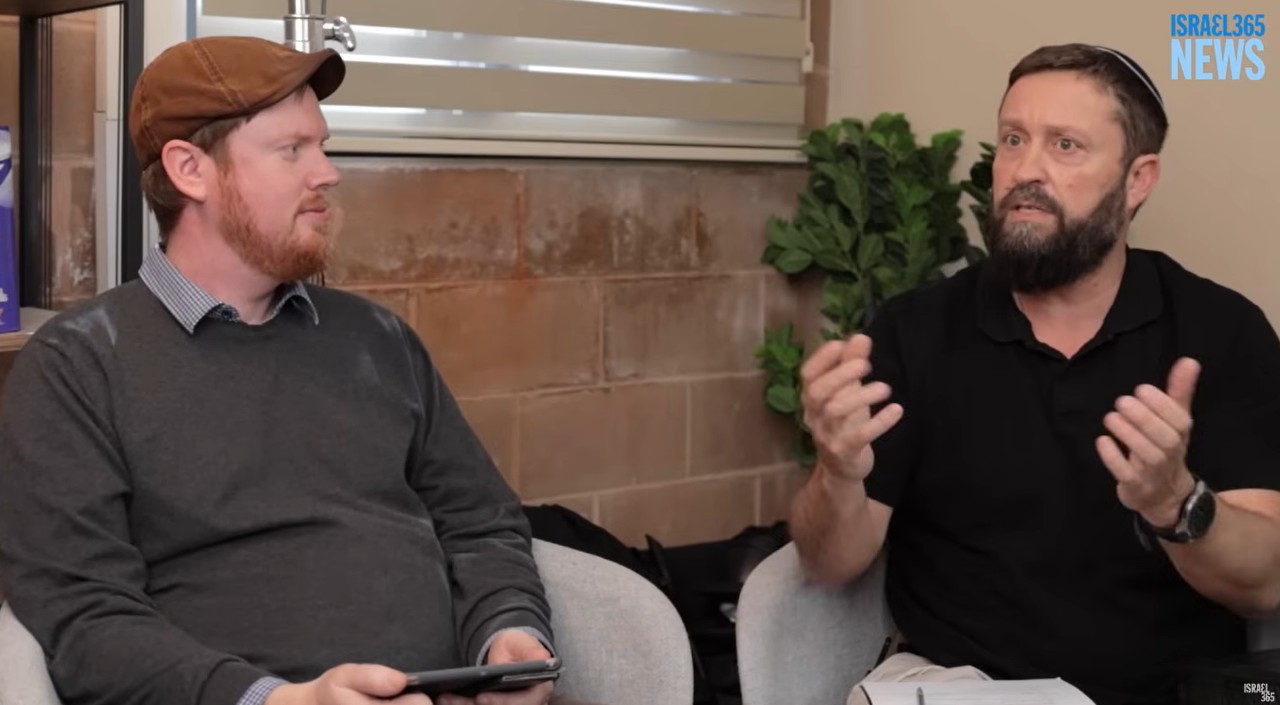
A forum discussion between two Jews and a Christian led to a candid and intense discussion over the question of whether the meeting between Christian Zionism and Orthodox Judaism is leading to a desecration of the Torah Jews have treasured and protected since the revelation at Mount Sinai. The three men sat down on Tuesday to wrestle with this loaded question, each bringing a different lens to examine the same redemptive moment in history. What emerged was not a comfortable consensus but something more valuable—honest dialogue that exposed both fears and hopes as Jews and Christians navigate uncharted waters in the march toward geula.
While it is blessed and welcome when Christians start keeping Shabbat, lighting Hanukkah candles, and conducting Passover seders, what happens when they reject rabbinic Judaism entirely? What does it mean when believers claim to be physical descendants of Ephraim, saying they are the lost tribes returned? These questions drove Adam Eliyahu Berkowitz to write an editorial two weeks ago titled “Is Christian Zionism an Existential Threat Destroying Jews and the Nation of Israel?” The piece sparked responses from Rabbi Ari Abramowitz, who was motivated to write a response, “The Jewish People Are Not Fragile.” Christian Zionist John Enarson led this forum discussion that Israel365News published on Tuesday.
Berkowitz opened the discussion by laying out two phenomena that triggered his editorial. “One of them is an increasing move within Christian Zionists towards Torah and Jewish practices,” he explained. “Christians taking on the Passover Seder, Christians doing Hanukkah, Christians doing Shabbat, which I of course believe is a blessed appearance.”
But there’s a catch. “I’ve noticed that when Christians do that, they’re very careful to reject what they call rabbinic Judaism,” Berkowitz said. “And they also reject the oral law, the Talmud, what Jews call halacha, and the rabbinic process. And it leads to them doing the mitzvot in a characteristically non-Jewish manner.”
The problem runs deeper than practice. “They also have been acquiring Hebrew terms to refer to things that they believe theologically that are not the same as what Jews use those same terms for,” Berkowitz noted. “For example, ruach is not the same as what Christians mean when they say the Holy Spirit. And they’ve even been taking on terms like YHVH, which is supposed to be like the unutterable name of God, which Jews avoid even hinting at.”
The second phenomenon troubles him more: “Christians referring to themselves as Ephraim, meaning that they are the embodiment of the lost tribes of Israel, and they say we have returned.” These believers claim physical descent from the tribes, using terms like “grafting” to describe their status. “They say yes, we are really a tribe. We are the physical manifestation of the tribe of Israel.”
The stakes escalate when you consider the Third Temple. “As we come closer to geula, to the redemption, one of the major problems that’s going to happen is will they enter the Temple because only Israel is allowed to enter into the Temple,” Berkowitz warned. He cited a disturbing example: “There was one time they held a reenactment, a temple reenactment, and the Temple Institute sent me a photo of a man. They said, ‘Do you know this guy?’ And I’m like, ‘No.’ And I was looking at it was a non-Jew who dressed up like a Cohen, but his clothes weren’t exactly right. And when they asked him, ‘Are you a Cohen?’ he said, ‘Yes, in the tradition of Melchizedek.'”
Then there’s the issue of a man “sprinkling ashes of a non-kosher red heifer that was burned, and he’s sprinkling it on non-Jews, Christians in America, saying since we believe in Jesus, we are Ephraim and we are Israel and we need to be purified. So he’s using those ashes. Now those Christians will say we’re Israel, we’re purified, so we can go up to the Temple.”
Rabbi Ari Abramowitz responded with vulnerability and vision. “When I read it, I did not reject it as unfounded,” he admitted. “As a matter of fact, I think the reason I was so moved to write a response is because I identified with it so strongly. The majority of my life, I would say I held exactly that position and that posture.”
But something shifted when Abramowitz moved from America to Israel and helped establish the Arugot Farm in Judea. “One of those prophecies is that when we return to the land, he will take from us a heart of stone and put within us a heart of flesh that we’ll have a circumcision of the heart,” he said. “And that journey for me of what I feel like that experience is the slowly opening of my heart.”
Abramowitz described his transformation from a defensive posture to one of blessing. “When I meet Christians now, I’m not in a defensive, reactive posture, but a posture that is only the consequence of a God-given gift that is the result, I believe, of a Jew living in Judea. I no longer feel threatened, but I feel love.”
His perspective on Christian seekers comes from humility about his own journey. “When I look at the way I understood God 10 years ago, I see half of that was wrong,” Abramowitz said. “I hope and pray that 10 years from now, half of the way I understand God right now will be wrong. None of us can ever fully understand God.”
He rejects the model of Jews hoarding Torah. “Our mission is not to be insular and to hoard the Torah to ourselves, but rather to be the vehicle to actually fulfill the mission that the Torah gives us to be a mamlechet kohanim v’goy kadosh, a kingdom of priests and a holy nation.” He explained: “Just as the Cohen’s job is to bless us, it is our job to bless the nations of the world. And that blessing is a different posture than judgment.”
Regarding Christians who attempt Jewish practices, Abramowitz takes a generous view. “A lot of these Christians that are on their journey, and it’s somehow a little bit messy, a little bit confused, disorienting, especially for them. I have tremendous respect for them. It’s hard to reject generations of a certain paradigm and open your heart and your mind to another.”
He refuses to police outcomes. “My mission is to share the beauty and the depth of the Torah that lights up my own soul and to share that and let the cards fall where they may,” Abramowitz explained. “Some people may convert to Judaism. That’s not my goal. We’re not an evangelistic, proselytizing people. As a matter of fact, when they come to me to do that, I tell them maybe you should think twice.”
John Enarson brought crucial context about the Christian world. “I think it’s important to know that Christianity is by far the world’s largest faith. It’s 2.3 billion adherents,” he noted. “I would say probably roughly half of them are generally pro-Israel, support that the Jewish people have been given the land of Israel.”
But the phenomenon Berkowitz described represents a tiny fraction. “Of this whole 2.3 billion Christians, maybe there’s half a million that are kind of involved in this process of drawing towards Torah,” Enarson estimated. “And of those, there is really a segment of those that believe that they are the 10 lost tribes that they’re physically descended from Israel and claim that identity. So that’s quite a small minority.”
Enarson identified himself as “a post-supersessionist Christian. It means somebody that’s rejected replacement theology.” He explained his position: “I believe Jews all over the world should remain faithful to the covenant of Torah in a traditional manner, and I support all the major streams of Jewish practice as a Christian. As a gentile Christian, I don’t believe I am beholden to the same number of mitzvot. But to enrich my faith, I choose to celebrate a number of festivals, Passover, commandments, a bit of kosher, liturgy, similar to like the ger toshav perhaps in Jewish thought.”
He drew a clear line: “I don’t agree with this small minority in the Hebrew roots movement that wants to say the divine name, that wants to wear tzitzi,t that wants to appropriate really Jewish mitzvot in a pretty disrespectful manner. I don’t think as a gentile Christian you should be engaging in some of those mitzvot to that level.”
On the lost tribes claims, Enarson was blunt. “I would disagree generally that the majority of those people claiming to be [the] 10 tribes, [claiming] to be [the] lost tribes of Israel, that that’s actually true.” He pointed to similar movements: “I believe that the black Hebrew Israelites claim this, for example. I believe that even the Mormons actually believe that they are lost tribes.”
When Berkowitz pressed Enarson on how to teach mitzvot to Christians “in a way that will open them up to the oral law, the Talmud,” Abramowitz pushed back on the premise. “We’re not—this is not an era of policing,” he said. “I think that a big part of the reactionary reality in America towards Jews and a lot of things is from over policing and over-censoring. Let anyone say whatever they want to say, and however they want to say it.”
Abramowitz rejects outcome-based teaching. “I don’t think I try to teach without any outcomes. My mission is to share the beauty and the depth of the Torah that lights up my own soul and to share that and let the cards fall where they may.”
He offered a powerful analogy about spiritual progress. “An atheist—I used to be an atheist. The worst. But is an atheist—maybe an atheist would actually reach the highest rungs of heaven. Why? I remember the story about Rabbi Shlomo Carlebach. Someone was sitting at a Shabbat table, and they said, ‘You know, Rabbi, I don’t believe in God.’ And he said, ‘My friend, my brother, that God you don’t believe in, I don’t believe in either.’ “
Abramowitz continued: “Maybe a child sacrificing pagan that says you know what if this is God then I don’t believe in God. Well, on the ladder from falsehood to truth, they have just taken a huge leap towards truth. So if they die at that moment as an atheist, well, they’ve just gone from a child sacrificing pagan, religious pagan to someone that rejects all of that.”
When Berkowitz expressed terror at teaching Christians Hebrew lest they try to pronounce God’s name, Abramowitz addressed the fear directly. “The Sages say that fear is idolatry,” he said. “Why is fear idolatry? Because you’re afraid something may happen what shouldn’t happen. But if you know that everything that happens is from God and it’s good, then there’s no reason to ever fear.”
He challenged the possessiveness over Torah. “The Torah isn’t really ours. It is—the Torah was given to us by God, but not in order to keep to ourselves. Our mission with the Torah is to be vessels and vehicles through which we’re supposed to funnel that to the world.”
On Christians attempting to say God’s ineffable name, Abramowitz showed no concern. “The name is ineffable. Meaning that even we don’t know how to say it. Even we can’t even pronounce it if we want to. The greatest rabbi in the world can’t pronounce it because that’s the whole idea of this name. It’s beyond us. So, I’m not worried about them actually saying it right because they can’t and we can’t.”
Berkowitz pressed his concern about the future Temple. “As we come closer to geula, one of the major problems that’s going to happen is will they enter the Temple because only Israel is allowed to enter into the Temple,” he said, later adding: “I envisioned an altar with a huge cross on top of it.”
Abramowitz dismissed the fear as unfounded. “Don’t worry about that happening in the Temple because it’s one thing to happen in a Temple reenactment. It’s another thing to take the most contentious, sensitive area in the world and build a Temple on it. And when this happens, we’re going to be beating our swords into plowshares. Iran is going to be sending delegations to offer sacrifices in the Temple. The world is going to be so radically different that we don’t need to worry about that dude with the thing.”
He challenged Berkowitz’s catastrophic imagination. “You have to keep in mind, Rabbi Adam Berkowitz, that our mind is also the sanctuary of our soul. And so even to allow ourselves to envision a crucifix in the Holy of Holies, it’s so—number one, it’s absurd. It’s crazy. It’s not real. So why is that something that should cause you fear?”
The conversation shifted to actual threats. Enarson noted: “People that claim to be spiritually Israel to have taken the identity—and they are getting now, especially in the kind of hardcore neo-rad movement and in the traditional Catholic movement, there’s a real macho resurgence of real raw Christian anti-Semitism.”
He continued: “I see a real danger in the diaspora that they are going to come for the Jewish people at some point. And that I think is a test for real God-fearing Christians—how are we going to protect the Jewish people in the diaspora and help them home.”
Berkowitz was shocked when Abramowitz said replacement theology was declining. “It seems to me it’s having a very precipitous comeback,” Berkowitz countered. “Now it may be having this comeback because it’s always darkest before dawn, and it’s the death throes of this philosophy. But the fact is, to have it now, I can understand replacement theology 500 years ago when we’re getting massacred in a pogrom in Hungary. But now, now when all of the prophecies are being fulfilled, the revival of the Hebrew language, the ingathering of the exiles, the land of Israel.”
Abramowitz agreed that this paradox reveals something important. “That’s why this whole idea of pro-Israel Christians connecting to the roots is happening because an intellectually honest person sees what God is doing to his nation. He’s like, ‘Oh, they actually are the Jewish people the whole time. Let us connect to them.'”
Abramowitz quoted Zechariah: “The righteous of the nations will attach themselves to the house of Israel on that day and be for me like a nation. What does that mean like a nation? I don’t know. But there is some sort of deeper merging that happens.”
He defined what it means to attach to Israel. “A German that hid a Jew in their house in World War II, if they were caught, they would end up in the gas chambers of Auschwitz right next to that Jew. So when you tie your fate with the fate of Israel, when you cast your lot with the Jewish people, and you’re willing to suffer because the days are coming where there will be suffering that will be demanded for those that stand with Israel. Speaking out for Israel, there will be a price to pay.”
Enarson affirmed this commitment. “There have been believers in Jesus who have been murdered because they support Israel.” He added: “The test is 100% going to be less about those theological nuances. The pressure will come. Will we stand? We will be tested in our faith in the Bible but also tested in our allegiance to protecting the Jewish people.”
The conversation turned to the crisis facing diaspora Jews. Abramowitz read from Ezekiel 36:22-26: “Thus said the Lord, Hashem Elohim, it is not for your sake that I act, oh house of Israel, but for my holy name that you have desecrated among the nations where you came. I will sanctify my great name that is desecrated among the nations that you have desecrated among them. Then the nations will know that I am Hashem, the word of the Lord, Hashem Elohim. And I will become sanctified through you before their eyes. I will take you from among the nations and gather you from all the lands, and I will bring you into your own soil.”
He explained: “God is saying there that the very existence of the exile of the diaspora is a desecration of his name. That the nations say, ‘How great can the God of Israel be that his nation is scattered around the world?’ So for all of these religious, God-fearing, ultra-Orthodox, nuanced Jews of the exile, they’re missing the forest for the trees to come back to the land.”
Abramowitz then referenced Jeremiah 16, where God promises to send fishers and hunters. “People like Yuval Fleer that are going and sharing the beauty of Israel and the mission and the passion and the purpose” are the fishers. “I would personally rather live in a beat-up leaky caravan on a mountaintop in Judea, surrounded by jihadists, than in a mansion in New York or Florida. And it’s not even close.”
But for those who don’t respond to the fishers, hunters are coming. “Hunters like Candace Owens, like Tucker Carlson, like Dan Bilzerian, like Anna Kasparian, like these people that are really pushing hard the narrative that not Israel, but Jews, Jews are sinister and evil, and it’s coming from the righ,t and it’s coming from the left.”
Abramowitz painted a dire scenario. “All it’s going to take is one black swan event, one unforeseen circumstance, and this tinder box that we call a world, all of a sudden, Israel attacks Iran, Iran attacks Israel, America attacks Iran, the skies shut, no air travel, something happens, and then there’s empty grocery store shelves. Those Jews are going to be getting it from the right and the left. And this illusion of security is going to be shattered in a moment.”
His message was urgent: “That’s what keeps me up at night. That’s what I’m consumed with. That’s what my prayers are about. And that’s why I say to Jews, number one, pack a backpack and come here. I’m not asking you to make aliyah. That’s a huge commitment. Just come for a year. And if you don’t like it, you could go back.”
To Christians, his message was equally clear: “Fortify yourself and trust and [have] faith in the God of Israel. And if you feel it in your heart and you feel compelled to do so, have courage and strength to go and defend and protect your Jewish brothers and sisters that are going to be in a tremendous amount of fear and disorientation and tremendous danger.”
Enarson echoed this priority. “That’s the same thing that’s keeping me up at night from the Christian side of things is to get the church ready for that and to take the right stand.”
Near the end, Enarson raised Berkowitz’s term “appropriation theology.” He noted: “Really, Christianity is entirely built on an appropriation of just all Jewish concepts. It’s 12 Jewish guys 2,000 years ago who introduced us to the Jewish Bible, a particularly Jewish way of interpreting it, which we call the New Testament, a Jewish concept of the Messiah, of resurrection of the world to come. And basically the entire Christian faith is appropriating Jewish context and in a particular way applying it to the nations.”
Abramowitz reframed the concern. “Another word for appropriation is flattery. They are coming and saying, ‘There’s truth to this, and we want to broadcast that to the world and we want to live by it.'”
He acknowledged that Christian teachings can veer off course. “When you shoot a missile 500 kilometers, 0.01 degrees off, it’s going to land 13 kilometers to the right. And so a lot of Christian teachings that I think are way off are actually coming from a true place that has just been misunderstood. And just as we’re clarifying our own misunderstandings, if they come to us and ask us, we can clarify theirs.”
But Abramowitz set priorities. “These people that are wearing tzitzit on their belt loops, for me, it’s very easy to love them and bless them. A bigger challenge is the Tucker Carlsons and the Candace Owens with seething hatred, but I really try to love them too.”
Berkowitz wanted clarity. “I don’t want anyone to misunderstand me since I’m playing the bad cop on this panel. The thing that unites the three of us most strongly is [that] we all three believe that geula, redemption, Messiah is coming, and we don’t know how it’s going to come, but we know that an essential part of that process is the reunification of Jews and Christians…coming together. And not just they’re supporting us, but mamash brothers.”
He offered an analogy: “I compare it to two people slow dancing with headphones listening to different music. There’s going to be some sore toes at the end. But we have to learn to love each other anyway, to forgive each other, and to keep dancing anyway because it’s a good thing.”
Abramowitz questioned the framework of mutual forgiveness. “Sometimes I wonder, there’s been so much hatred between us for thousands of years. I’m like, not exactly. Do we really need to forgive each other, or do we need to forgive them? Because I mean, we weren’t exactly committing genocide against them and were the recipients of tremendous amounts of persecution.”
But then he took a different turn, defining redemption itself. “I always wondered what the difference between salvation and redemption? I think salvation is when we’re surrounded by 23 Arab states, 57 Muslim states, and Hamas and Iran, and they’re coming against us, and God saves us. Redemption is where we’re able to look back at all of the pain and the suffering and all the October 7ths and say now we can see why that needed to happen to bring us to the place that we are right now.”
He continued: “If we believe that ein od milvado, there’s nothing but God in the world and that everything is for the good because God is good,then everything that happens to us, it doesn’t happen to us, it happens for us, including October 7th, as painful as it is to say. It didn’t happen to us, it happened for us.”
Abramowitz described what he’s seeing on the front lines. “When you go to the different units in the army, I was in Golani, the patch of the tree, and then there’s tankhanim, the paratroopers, and they have a snake with wings – they’re all pulling off their patches, throwing them away, and putting this patch: it says Messiah and a picture of the temple.”
He paused, emotional. “Because it’s waking us up to our mission, to who we are.”
Then Abramowitz offered a startling thought. “I can’t help but to feel, looking back at history, maybe there is something for them to forgive us for. Because I can’t help but to think that on a deep visceral level, the Jew hatred throughout the generations has been from a deep subconscious anger at us for not being who we’re supposed to be and not doing what we’re supposed to do.”
Berkowitz interrupted: “Which is why now that we are doing what we’re supposed to do, they love us.”
Abramowitz agreed. “Go figure.”
But then he added the key: “Who loves us and who doesn’t? Because we can only truly do what we’re supposed to do when we’re back in the land.”
Abramowitz revealed the price he’s paid for this work. “My roughness in my journey has been about my fellow Jews. The amount of rage and attacks that I have faced in my work with the Christian world and my mission with the Christian world that I think is holy.”
He described the attacks. “I remember someone once took a picture of me on stage and photoshopped a picture of an Easter bunny wearing a tallit, a Jewish prayer shawl, and put it out there, and everyone’s like, Ari, how can you do this? … there have been attacks like that that have been just so vicious, and I’m like, why? We’re actually waking up to the fact that we have a mission to the nations of the world.”
Yet he persists because of what he gains. “When I sit with a Christian, when I sit with someone like you, and you have a question for me, that question is a question from your unique background and perspective that I’ve never heard, and the answer that comes from me strengthens you, and your words strengthen me. And so we both emerge from this interaction feeling closer to God without having changed each other at all. That to me is a godly thing.”
The three men ended where they began; not in perfect agreement but in shared purpose. They wrestled with messy realities: Christians claiming tribal identity, theological confusion, the specter of replacement theology, and most urgently, the gathering storm facing diaspora Jews.
Berkowitz’s fears about Christians misusing Torah are real. His concerns about the Temple carry weight. But Abramowitz’s response cuts deeper—that fear itself becomes idolatry when it blocks the mission God gave Israel to be a light to the nations. Enarson confirmed what many miss: the vast majority of Christianity remains disconnected from these issues, and the small minority causing concern does not speak for the faith.
What emerged from this hour-long conversation was a picture of redemption that looks nothing like tidy theological categories. It looks like a chicken farmer in Judea inviting seekers to sleep in tents. It looks like soldiers ripping off their unit patches to wear one that says “Messiah.” It looks like Christians ready to risk everything to protect Jews when the hunters come. It looks like Jews and Christians slow dancing to different music, stepping on each other’s toes, but refusing to stop because they know they’re dancing toward the same destination.
The question isn’t whether this process is comfortable; it isn’t. The question is whether it’s real. And watching three men from different worlds speak with such honesty about their fears and hopes, their disagreements and shared mission, suggests that something is shifting. The nations are beginning to see what God is doing with Israel. Jews are beginning to reclaim their role as priests to those nations. And the messy, confusing, sometimes painful process unfolding between them might just be what redemption looks like when it’s actually happening.

