


For nearly two thousand years, the stones of Jerusalem’s main pilgrimage artery lay buried beneath ash, rubble, and a living city. On January 20, that silence ended. For the first time since the Roman destruction of Jerusalem in 70 CE, visitors can now walk the full length of the Pilgrimage Road in the City of David, a broad, stone-paved street that once carried multitudes of Jews ascending from the Pool of Siloam toward the Bais Hamikdash, the Holy Temple, during the Second Temple period. What had long been read in Scripture and described by the Sages has now emerged again as physical fact beneath modern Jerusalem.
The Pilgrimage Road stretches roughly 600 meters and measures about eight meters wide. Archaeologists date its construction to the early first century CE, based on coins found beneath its paving stones. The street linked the Shiloach (Pool of Siloam), where pilgrims immersed in mikvaos—ritual baths—to the southern approach of the Temple Mount. It functioned as the city’s main processional route during the Biblical Feasts—Pesach, Shavuos, and Sukkos—when Jerusalem swelled with pilgrims from across the Land of Israel and the wider Jewish world. Excavations conducted over roughly two decades by the Israel Antiquities Authority uncovered the road section by section, preserved beneath debris from the Roman destruction.
The Bible presents pilgrimage to Jerusalem not as symbolic devotion but as commanded action, grounded in place and movement. “Three times a year all your males shall appear before the Lord your God in the place that He will choose: on the Festival of Matzos, the Festival of Weeks, and the Festival of Booths” (Deuteronomy 16:16). The Pilgrimage Road is the architectural expression of that commandment. Jews did not merely arrive in Jerusalem; they ascended, step by step, from purification in water to encounter with the Divine. The Sages emphasized that physical ascent prepared the pilgrim for spiritual elevation. The road’s unique stepped design—two shallow steps followed by a broad landing—slowed the climb, turning the journey itself into an act of intention and reverence.
Walking the road today reveals a Jerusalem that was crowded, commercial, and intensely Jewish. Alongside the paving stones, archaeologists uncovered coins, stone weights, shopfronts, and remnants of small businesses that once served pilgrims on their way to the Temple. Beneath the street runs a large drainage channel, now partially open to visitors, where Jewish residents likely hid during the Roman siege. These findings align closely with descriptions in rabbinic literature of Jerusalem at its peak, when the city served as both a spiritual center and a thriving urban marketplace.

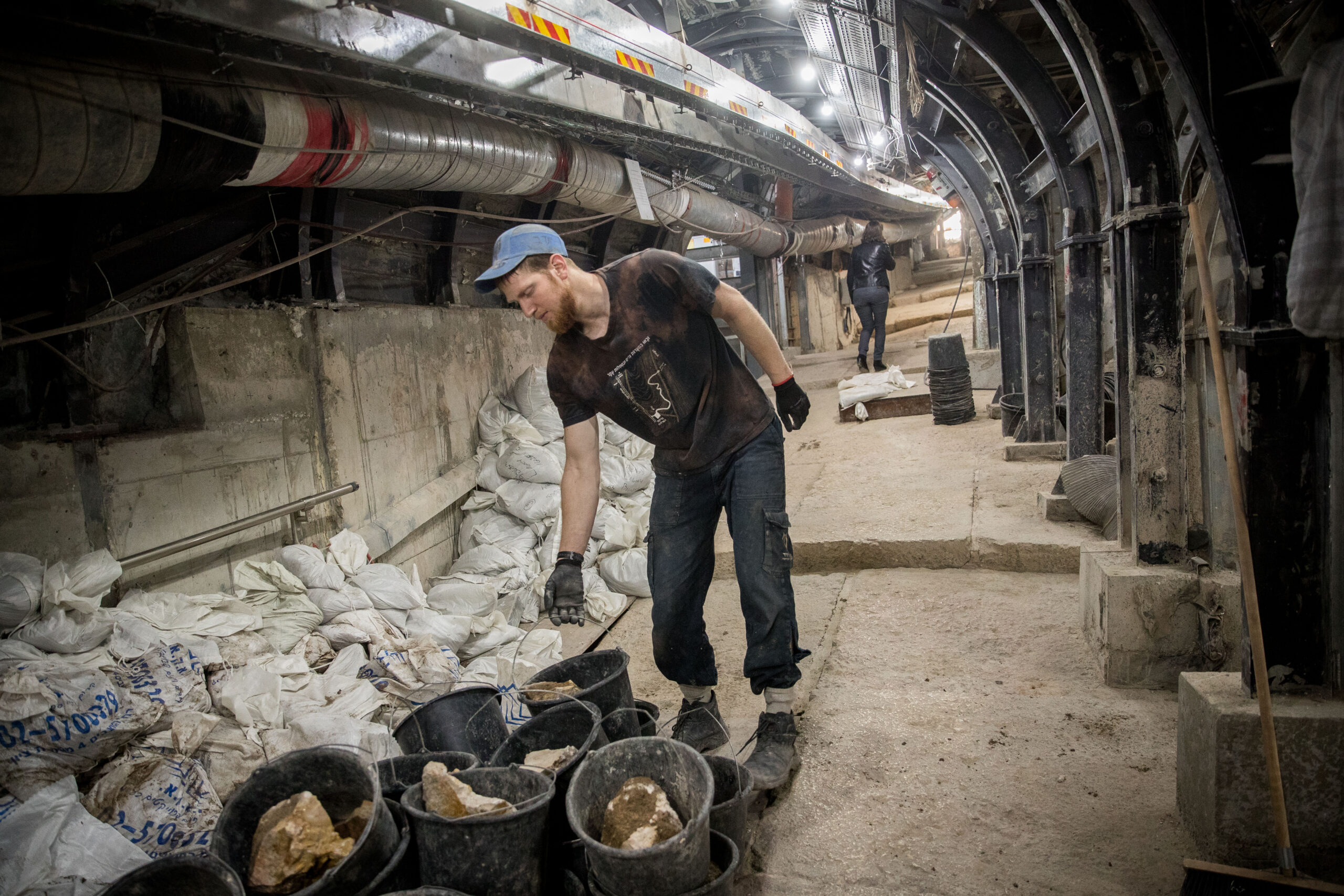
The road begins near the ancient Pool of Siloam, at the southern entrance to the city, and runs northward beneath today’s buildings to the Jerusalem Archaeological Garden near the Western Wall. Excavating the street required complex engineering. Because modern homes and roads sit directly above it, the project proceeded horizontally, reinforcing the route with steel and concrete supports while preserving daily life above ground. Amit Re’em, the Israel Antiquities Authority’s chief archaeologist for Jerusalem, described the discovery as “one of the most magnificent archaeological finds in Jerusalem in recent decades,” noting that for the first time it is possible to see a direct, continuous link between the Pool of Siloam and the Temple Mount.
The site lies within the City of David, the oldest settled core of Jerusalem, and contains archaeological layers spanning from the First Temple period (roughly 1000–586 BCE) through the Second Temple period, which ended in 70 CE. The park is operated with the support of the City of David Foundation, which works to develop and preserve the site. Excavations over the years have drawn international attention, including visits by foreign dignitaries. In September 2025, Israel officially inaugurated the completed route in a ceremony attended by Israeli leaders and international guests, marking the first time the road was fully accessible from end to end.
Since the opening, guided tours have been leading visitors along the entire length of the Pilgrimage Road. For religious Jews, the experience collapses the distance between text and terrain. The ascent described in Scripture is no longer abstract. The stones are worn smooth where millions of feet once passed. For historians, the road provides rare confirmation of Jerusalem’s central role during the Second Temple period, not as a marginal shrine but as the beating heart of Jewish national and religious life.
The reopening of the Pilgrimage Road is not a reenactment or a reconstruction. It is exposure. These are the original stones, laid by Jews for Jewish worship, buried by Rome, and now revealed again in Jerusalem. Empires tried to erase this ascent. They failed. The road endured, waiting beneath the city for the generation that would walk it again.
