

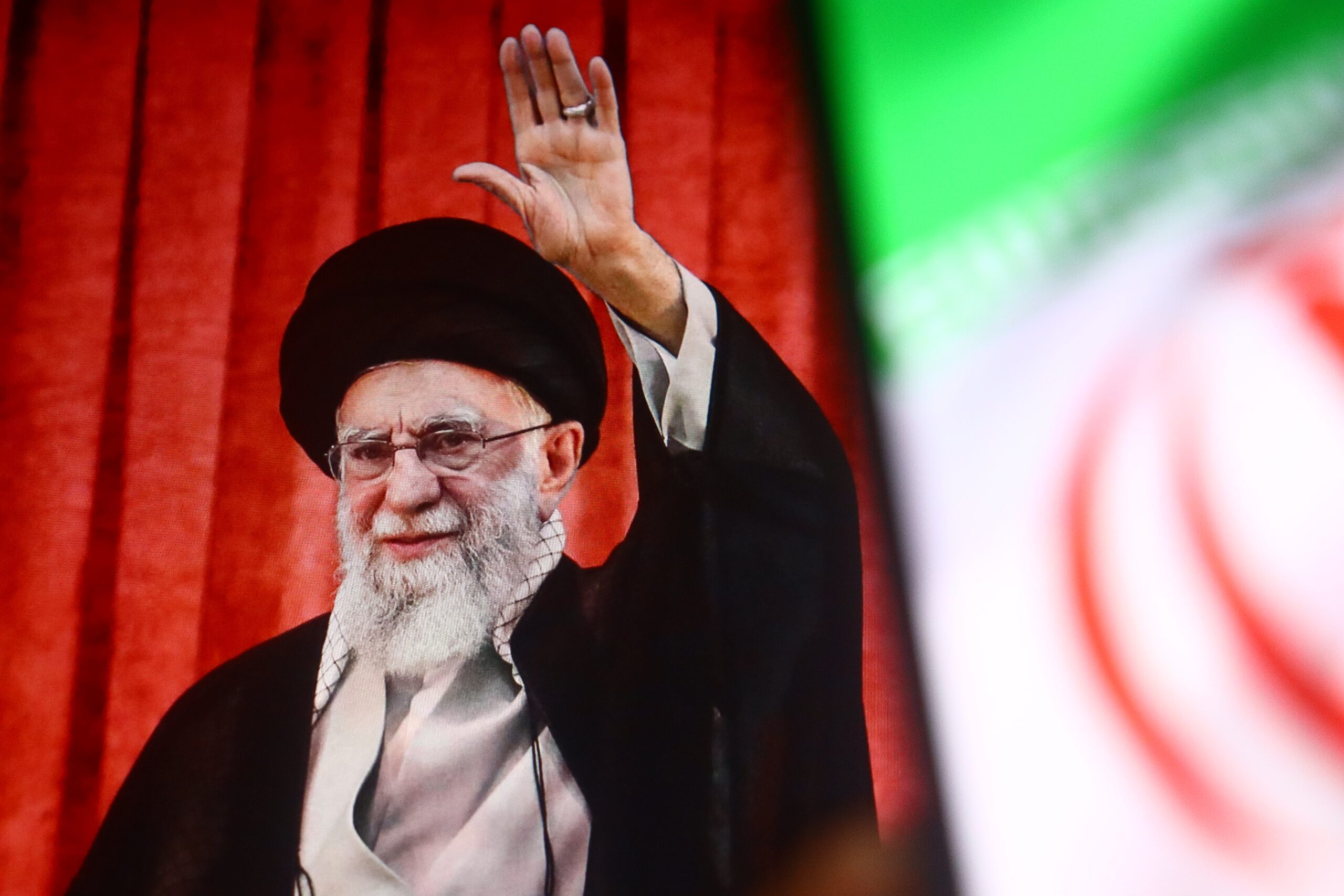
For weeks, Iran’s supreme leader vanished from public view as American warships closed in and internal unrest shook the Islamic Republic. Rumors spread rapidly inside Iran and across the region that Ayatollah Ali Khamenei had been moved into a hardened underground bunker, removed from sight as the regime braced for a possible American strike. Now, suddenly, state media is parading him in public, staging photographs meant to project calm and control. The timing is not accidental. It is a signal of fear dressed up as confidence.
Israel365 Newsreported that Khamenei went into hiding as tensions spiked between Iran and the United States and as Israeli and American forces increased their regional posture. Iranian officials denied the reports. Recent curated images were released showing Khamenei praying at the tomb of Ruhollah Khomein. The photographs were published on the anniversary of the Islamic Revolution, marking 47 years since 1979, and were clearly intended to counter claims that Iran’s supreme leader fears a direct American strike under President Donald Trump.
The messaging was reinforced by Iran’s military leadership. Iranian army chief Amir Hatami warned the United States and Israel that Iran’s forces were at full readiness. “If the enemy makes a mistake, without a doubt it will endanger its own security, the security of the region, and the security of the Zionist regime,” Hatami said, according to Iran’s official IRNA news agency. He insisted that Iran’s nuclear expertise could not be destroyed, even if Iranian scientists were killed.
Those words were delivered against the backdrop of severe internal instability. Nationwide protests erupted in late December over economic collapse, inflation, and rising living costs before expanding into open opposition to the regime. Iranian authorities admitted that more than 3,100 people were killed. Opposition sources placed the death toll far higher. Iran later acknowledged that children were among those detained during the crackdown, confirming what human rights groups had already documented.
As the regime struggled to reassert control, the country was shaken by a series of deadly explosions. On Saturday, at least one person was killed and 14 were injured in an explosion in the southern port city of Bandar Abbas, located on the Strait of Hormuz, a vital artery for global energy shipments. Iranian officials claimed the blast was caused by a gas leak. Mohammad Amin Lyaghat, a local fire chief, said the explosion resulted from gas buildup inside a building. Mehrdad Hassanzadeh, Hormozgan province’s crisis management director, confirmed that a four-year-old girl was killed.
🚨🇮🇷 BREAKING: Multiple explosions were reported in a residential building in the Azadegan neighborhood of Bandar Abbas in southern Iran.
— PLT Report (@pltreport) January 31, 2026
Initial reports indicating a gas leak as the cause. pic.twitter.com/B0MU3KWX41
A separate gas explosion in Ahvaz, near the Iraqi border, killed four more people, according to Iranian media. Iranian outlets rushed to deny reports circulating on social media that Revolutionary Guard commanders had been targeted. Tasnim News Agency labeled such claims “completely false.” Israeli officials also denied any involvement, and the Pentagon declined to comment.
These explosions followed months of unrest and came as Iran conducted live-fire naval exercises through the Islamic Revolutionary Guard Corps in the Strait of Hormuz. CENTCOM publicly warned the IRGC against unsafe behavior near American forces. The United States designated the IRGC a terrorist organization in 2019, a designation the European Union formally adopted this week, drawing furious condemnation from Tehran.
Iran’s leadership insists that these events are unrelated, isolated, and accidental. The Bible does not treat cascading disasters as random noise. It treats them as exposure. “When the wicked rule, the people groan” (Proverbs 29:2). The verse does not speak in metaphors. It describes political reality. A regime that survives through fear eventually becomes ruled by it.
President Masoud Pezeshkian accused the United States, Israel, and Europe of exploiting Iran’s economic crisis and fomenting unrest. In a nationally televised address, he claimed foreign powers were trying to fracture Iranian society from within. At the same time, he urged his government to serve the people more justly, an admission that the grievances are real and deep.
