



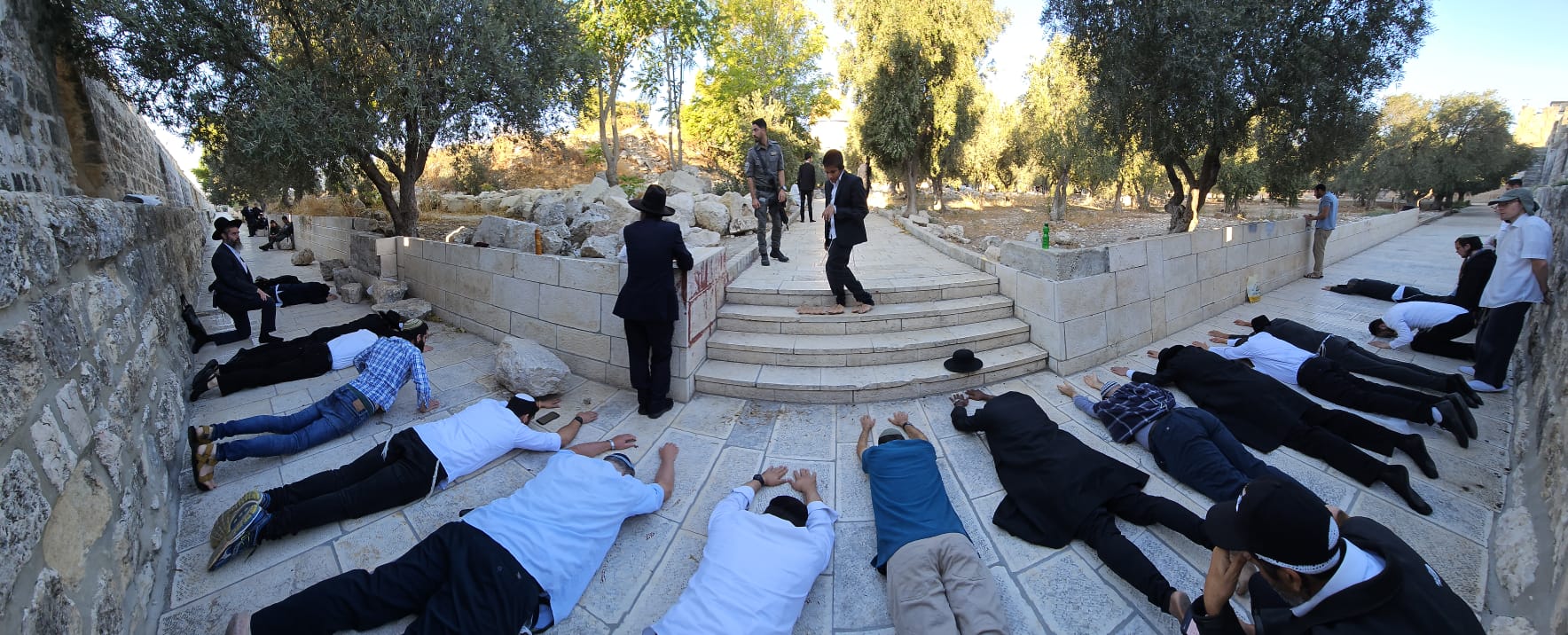
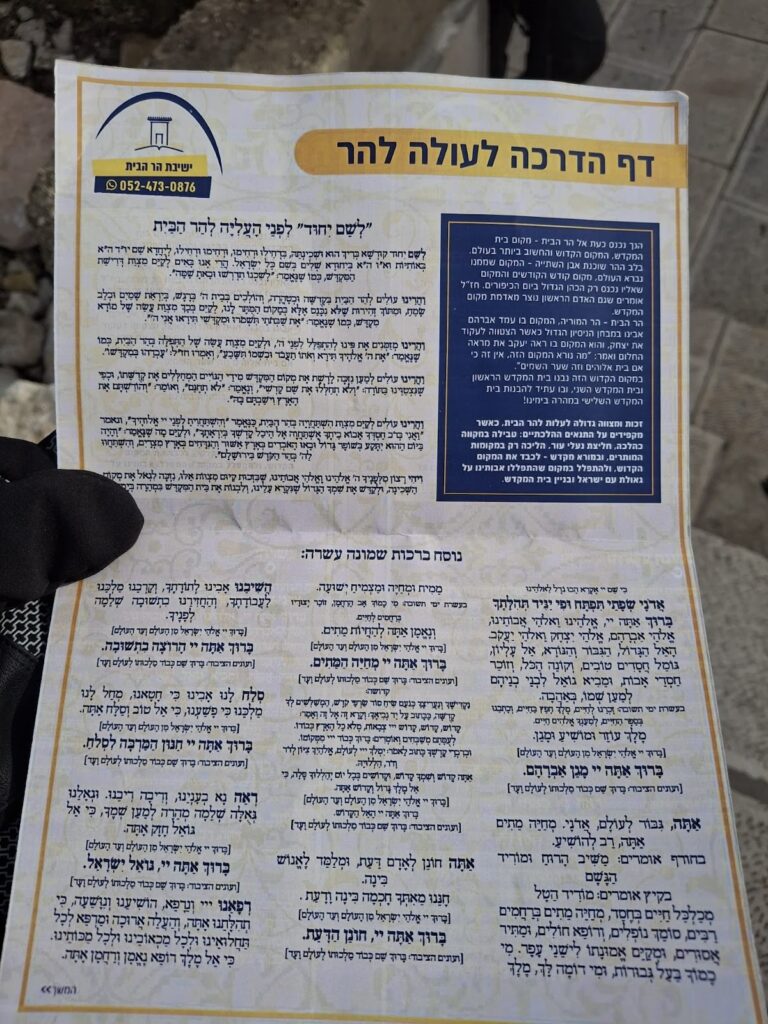
In a shift that brings Jewish worship on the Temple Mount closer to normalcy, Israeli police permitted Jewish visitors to carry printed prayer sheets onto the holy site on Wednesday. Students from the Temple Mount Yeshiva distributed liturgical materials to Jews waiting to ascend, marking what activists describe as official recognition of practices already taking place on the ground.
The flyers included religious guidelines for visiting the site, a prayer to recite before ascending, and the Amidah (standing prayer), recited three times daily in Jewish tradition. Police approved the Temple Mount Yeshiva’s request for visitors to bring these “guidance sheets” onto the complex, though usage remains limited to specific police-defined areas.
The Long Road to Religious Equality
For decades, police enforced a policy that barred Jewish prayer at the Temple Mount despite its status as the holiest site in Judaism. Officers routinely ejected or detained Jewish visitors caught praying. This discrimination persisted even though Israel captured the site in 1967 and maintains sovereignty over it.
The situation began changing three years ago under National Security Minister Itamar Ben Gvir, who has demanded that police allow Jews to pray at their holiest site. Jewish visitors were granted permission to pray and prostrate themselves in the eastern section of the complex, though bringing prayer items such as tefillin (phylacteries), prayer shawls, and printed liturgy remained forbidden until now.
This new policy comes more than ten years after a 2015 Magistrate’s Court ruling that freedom of worship and religious equality are mandated at the Temple Mount. The court permitted police to implement security measures but affirmed the basic right of Jews to pray at their holiest site.
Current restrictions on non-Muslim access remain severe. Jews and Christians can visit only during limited hours on Sunday through Thursday, with no access on Friday, Saturday, or Muslim holidays. Non-Muslims cannot bring any religious items onto the site and face immediate removal if caught engaging in visible prayer.
Palestinian Reaction
The Palestine Press Agency condemned the move as “a violation of the sanctity of Al Aqsa.” The outlet claimed this was “the first time” Israeli police allowed what they termed “settlers” to bring “Jewish prayer papers” into the compound.
“For the first time, and in violation of the sanctity of Al-Aqsa Mosque, the occupation authorities allowed the entry of ‘Jewish prayer papers’ with the intruders,” the headline read in Arabic.
The Palestinian report invoked the so-called status quo, claiming it has existed since before 1967, under which Jordan’s Islamic Waqf manages the site. The report cited left-wing Israeli media outlet Haaretz, describing the prayer materials as “Jewish prayer books or printed copies thereof containing Torah texts and Jewish prayers.”
“The status quo at Al-Aqsa has been in place since before Israel occupied East Jerusalem in 1967, according to which the Islamic Waqf Department in Jerusalem, affiliated with the Jordanian Ministry of Awqaf, is responsible for managing the affairs of the mosque,” the Palestinian outlet stated. It noted that in 2003, Israeli authorities changed this situation by allowing increased Jewish access, which the Waqf has demanded be stopped.
The Myth of the Status Quo
The term “status quo” at the Temple Mount refers to an Ottoman firman (religious ruling) issued over a century ago that favored Muslim claims to the site. This Ottoman decree has been used for decades to justify discrimination against Jewish worship.
Following the 1967 Six-Day War, Israel and Jordan reached an agreement that explicitly stated Jews would be afforded freedom of worship at the Temple Mount. Israel honored its commitment to allow the Jordanian-controlled Islamic Waqf to administer the site. Jordan never honored its commitment to allow Jewish prayer. For over half a century, this broken promise has denied Jews their most basic religious rights at their holiest location.
Biblical Foundations
The Temple Mount stands at the center of Jewish religious life, the site of both the First and Second Temples. The Bible declares its sanctity: “Three times a year all your males shall appear before the LORD your God at the place that He will choose: on the Feast of Unleavened Bread, on the Feast of Weeks, and on the Feast of Booths. They shall not appear before the LORD empty-handed” (Deuteronomy 16:16). This commandment, given to the Jewish people, establishes the Temple Mount as the focal point of Jewish worship.
The Sages teach that the site’s holiness derives from the Shekhinah (Divine Presence) that dwells there. Even after the Temple’s destruction, the sanctity of the location remains permanent.
Activists See Reality Overtaking Policy
Akiva Ariel, CEO of Beyadenu, an organization working to cement Jewish presence at the site, emphasized that the policy merely recognizes the existing reality. “Jews have been bringing prayer pages and books onto the Temple Mount for a long time, even if the police didn’t always want to see it. What happened now is simply the police officially approving what is already happening on the ground,” Ariel said.
“We are moving forward until prayer on the Temple Mount becomes a normal and routine reality,” he declared.
A Beyadenu spokesman noted the significance of the change, pointing out that such printed materials were “something that they [Israeli security] used to check for, to make sure you were not bringing” to the site. Currently, the police approved only the Temple Mount Yeshiva’s specific flyer, though this provision may expand in the near future.
Police confirmed their evolving stance in a statement emphasizing their work to “enable freedom of worship and visitation at the Temple Mount for all religions and communities.”
