




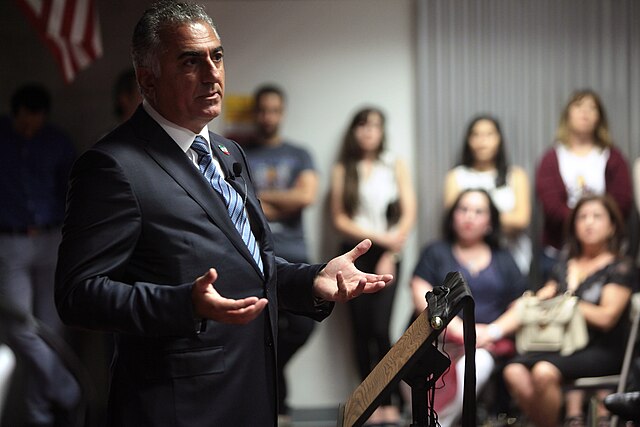
Iran’s exiled Crown Prince Reza Pahlavi told The Wall Street Journal this week that the Islamic Republic is collapsing from within and that Iranians themselves—not American military intervention—will bring down the regime. Speaking as nationwide protests against Ayatollah Ali Khamenei’s rule intensified, Pahlavi rejected speculation that Washington might extract the supreme leader or engineer a power transition, as President Trump recently accomplished in Venezuela. The Crown Prince’s comments came alongside his unveiling of a proposed “Cyrus Accords” framework that would establish full diplomatic and economic cooperation between a future democratic Iran and Israel, marking what he called the restoration of historic ties severed by the 1979 revolution.
Pahlavi described the current unrest as fundamentally different from past protests. “The conditions are right on many levels for the regime to collapse,” he said, noting that demonstrations now explicitly demand an end to clerical rule rather than merely voicing economic complaints. Asked about his own political ambitions, he deflected, saying his priority would be “healing a society that has been hurt, depressed, demoralized, cheated, lied to” rather than pursuing executive power. He insisted that accountability for regime leaders “will be far more appropriate” if handled by Iranians themselves, though he urged international governments to support the population’s push for freedom.
The Crown Prince sharply criticized recent American policy toward Tehran. He said the Obama administration abandoned the Green Movement in 2009, and he blamed the Biden administration for allowing the regime access to “over $200 billion of oil revenue” that was funneled to regional proxy groups rather than alleviating domestic suffering. He directly connected that policy to the October 7 massacre, arguing that American money strengthened Iran’s terrorist apparatus. By contrast, he praised Israel’s government, calling Prime Minister Benjamin Netanyahu “a very strong prime minister,” and said President Trump and Secretary of State Marco Rubio are pursuing a fundamentally different approach toward the Islamic Republic.
What Makes This Moment Different?
Pahlavi’s optimism rests on unprecedented street demonstrations that have spread from Tehran’s bazaar district to Isfahan, Mashhad, Ahvaz and Hamadan. The protests began after merchants shuttered shops to protest a financial crisis that sent the rial plummeting to 1.4 million per dollar on the open market, far from the official rate of 42,000. Economic rage quickly morphed into political defiance. Crowds chanted “Javid Shah”—Long Live the King—and “This is the final battle! Pahlavi will return,” according to videos circulating from inside the country. Other slogans targeted the regime’s regional priorities directly: “No to Gaza, no to Lebanon, I give my life for Iran.”
The reappearance of pro-monarchy chants represents a rupture in the Islamic Republic’s founding narrative. Public references to the Pahlavi dynasty have been taboo since 1979, when revolutionaries overthrew the Shah and established theocratic rule. The fact that Iranians now openly invoke the royal family signals rejection not just of policies but of the regime’s legitimacy. One Iranian opposition figure told The Jerusalem Post that the military could join the protesters if demonstrations continue and if Pahlavi demonstrates that his professional circle can govern effectively. “It is crystal clear that the population accepts the leadership of Prince Reza Pahlavi,” the source said.
The Cyrus Accords: A Vision for Post-Regime Relations
Pahlavi used the interview to unveil his vision for what he called the Cyrus Accords, a comprehensive framework for cooperation between a democratic Iran and Israel that would surpass the Abraham Accords in scope. He grounded the proposal in ancient history, citing Cyrus the Great’s ties to the Jewish people and noting that Israeli water-management technology could help Iran address severe environmental crises. He said Iranians envision a future built on cooperation with Israel and Arab states, and he argued that the hard-line rulers resisted regional normalization specifically to prevent that outcome.
The Cyrus Accords framework proposes cooperation across water and agriculture, energy and natural resources, technology and innovation, and tourism and culture. Iran faces a devastating water crisis, and Israel possesses advanced desalination and wastewater recycling capabilities. A delegation of professionals sent by the Crown Prince recently toured Israel’s Shafdan wastewater treatment plant and the Hebrew University’s Faculty of Agriculture to study Israeli methods. The delegation expressed interest in smart-grid technology and artificial intelligence applications to reduce gas loss, fix pipeline leaks and combat air pollution.
The accords also propose strategic partnerships combining Iran’s natural resources with Israeli technology, including joint pipelines to transport gas and oil to European markets via the Mediterranean. Energy cooperation would extend to renewable projects, particularly solar and wind. In the technology sector, the framework calls for joint venture capital funds to invest in startups in both countries, joint innovation parks, student and scientist exchanges, and collaboration in cybersecurity and artificial intelligence. Cultural initiatives would include Persian-language courses taught from Israel for Iranian students, daily direct flights between Tehran and Tel Aviv, and preservation of Jewish heritage sites in Iran.
Beyond bilateral cooperation, the Cyrus Accords envision expanding the existing I2U2 framework—currently including India, Israel, the United Arab Emirates and the United States—to include Iran and Iraq in a new structure called I4U2. This multilateral arrangement would address regional challenges including water scarcity, food security and energy security. The flagship project would be an economic corridor connecting Iran to Israel through Iraq and Jordan, serving trade, energy and fiber-optic communications. The corridor would link with the India-Middle East-Europe Corridor, making the region a junction for global trade routes.
The Abraham Accords demonstrated that Arab states and Israel can build productive relationships when freed from ideological constraints. The normalization agreements between Israel and the United Arab Emirates, Bahrain, Morocco and Sudan transformed regional dynamics, creating new trade partnerships, tourism links and security cooperation. The Cyrus Accords would extend that model to include Iran’s 90 million people and vast natural resources, creating an economic and political bloc capable of reshaping the Middle East.
Removing the Sponsor of Regional Terrorism
Eliminating the Islamist regime would remove Iran as the leading state sponsor of terrorism in the region. Tehran currently funds Hezbollah in Lebanon, Hamas in Gaza, the Houthis in Yemen and various militias in Iraq and Syria. The regime’s financial and military support enables these groups to threaten Israel, destabilize neighboring states and attack American interests. Pahlavi connected American policy that granted Tehran access to oil revenues directly to the October 7 massacre carried out by Hamas terrorists, arguing that those funds strengthened the infrastructure of terror surrounding Israel.
A democratic Iran aligned with regional partners would deprive these terrorist organizations of their primary patron, fundamentally altering the security environment. Hezbollah, Hamas, Islamic Jihad and the Houthis do not exist as regional forces without Iranian funding, training and direction. Ending the regime in Tehran would collapse the terror infrastructure that has threatened Israel for decades.
How Iranians View Cyrus and Their Biblical Connection
The accords draw their name and legitimacy from Cyrus the Great, founder of the Persian Empire in the sixth century BCE, who issued an edict allowing the Jewish people to return to Jerusalem after seven decades of Babylonian exile and rebuild the Temple. The decree appears in the book of Ezra: “Thus said Cyrus king of Persia: All the kingdoms of the earth has the Lord God of heaven given me; and He has charged me to build Him a house in Jerusalem, which is in Judah” (Ezra 1:2).
Among Iranians, Cyrus is not viewed as a foreign conqueror but as a national father figure. Cyrus the Great represents justice, restraint and respect for national and religious identity. His legacy stands in direct contradiction to the Islamic Republic’s ideology. The Sages noted that Cyrus’s decree reversed the catastrophe of the Babylonian conquest and made possible the Second Temple period. The historical memory connects Persia to Jewish redemption, and Pahlavi explicitly invoked that connection in positioning his proposed accords as a restoration of ancient ties.
Pahlavi directly addressed this shared legacy in a major speech delivered in May 2025 outlining the vision of the Cyrus Accords. “The name Cyrus reminds us of a deeper truth,” he said. “That the relationship between the Iranian and Jewish peoples is not a matter of modern diplomacy or fleeting politics. It is rooted in history—and one that is ancient, proud, and unique.”
He continued, “Over 2,500 years ago, it was Cyrus the Great, the Iranian king, who freed the Jewish people from captivity and allowed them to return to their homeland and rebuild their temple. That was not just an act of tolerance—it was an affirmation of religious freedom and human dignity.”
Pahlavi made a point of separating the Iranian nation from the regime that currently rules it. “Let me say this clearly,” he said. “The Iranian people do not seek enmity with Israel or with any of our neighbors. The Iranian nation seeks peace—real, durable peace—with the region and with the world.” He identified the true source of conflict as “an occupying regime—a violent theocracy that has no legitimate claim to speak for our people.”
He ended his May speech with an explicit call to reclaim that legacy. “Let tonight be the beginning of a new chapter,” he said. “A chapter where the ancient friendship between our peoples becomes a foundation for a new alliance of free nations.” He concluded, “Let us reclaim the legacy of Cyrus—not only in memory, but in action.”
Before 1979, Iran and Israel maintained close diplomatic and economic relations grounded in shared strategic interests and cultural affinity. The Islamic Revolution sought to erase that history by branding Israel “the little Satan” and making hostility to the Jewish state a cornerstone of regime ideology. Yet beneath decades of imposed enmity, Iranians retain a memory of closeness and a belief in a different future. When Iranians chant for the return of the Shah and invoke the Pahlavi name, they are rejecting the regime’s ideological foundations and recalling a time when Iran and Israel worked as partners.
Cyrus as Mashiach: A Prophetic Paradox
The book of Isaiah contains a passage that has fascinated Jewish commentators for millennia. Referring to Cyrus by name, the prophet declares: “So said the Lord to His anointed one (limshicho), to Cyrus, whose right hand I held to subjugate nations before him, and I will loosen the loins of kings, to open portals before him, and gates shall not be closed” (Isaiah 45:1).
The term mashiach—anointed one—typically refers to Jewish kings anointed with sacred oil, and its application to a gentile ruler is without parallel in the Bible. Rashi explains that Cyrus received this designation because he enabled the construction of the Second Temple. Ibn Ezra notes that mashiach in this context signifies divine appointment for a specific mission rather than the eschatological role reserved for the King Mashiach from the line of David.
The Sages understood Cyrus as an instrument of divine will who operated outside the covenantal framework yet fulfilled a redemptive function within Jewish history. His decree made possible the return to Zion and the rebuilding of the Temple, reversing the destruction wrought by Nebuchadnezzar. The application of the term mashiach to Cyrus establishes that God’s plan for Israel can work through unexpected agents and that redemption can arrive through political events that appear entirely secular.
If the Islamic Republic collapses and a democratic Iran emerges under Pahlavi’s leadership, the historical symmetry would be striking. A Persian ruler facilitating cooperation with the Jewish state and potentially enabling a Third Temple would echo the original Cyrus’s role in Jewish history. The resumption of Iran-Israel ties under a Pahlavi restoration would close a 45-year circle of hostility imposed by the Islamic Revolution and reopen a partnership rooted in antiquity.
The Temple remains central to Jewish eschatology, and any shift in regional politics that makes its construction more feasible carries prophetic implications. Cyrus’s decree led directly to the rebuilding of the Temple, a fact recorded plainly in the Bible and preserved in Jewish consciousness. The Temple was not a metaphor. It was a physical structure in Jerusalem, restored through Persian authorization. A future Iran aligned with Israel would fundamentally alter the regional dynamics surrounding the Temple Mount and Jerusalem’s future.
The Crown Prince’s framework calls for cooperation to begin even before regime change, focusing on projects that can proceed despite the current government. The accords are structured in three stages over a decade, from opening embassies and launching initial projects to completing core initiatives and creating an integrated economic space.
Whether Pahlavi’s predictions prove accurate remains to be seen, but the fact that an Iranian leader is publicly advocating for full relations with Israel and invoking Cyrus the Great signals a historic shift. The Islamic Republic built its legitimacy on hatred of Israel and rejection of the West. A future Iran embracing both would represent the regime’s complete ideological defeat and the restoration of ties that the Bible itself records as part of Jewish redemption.
