



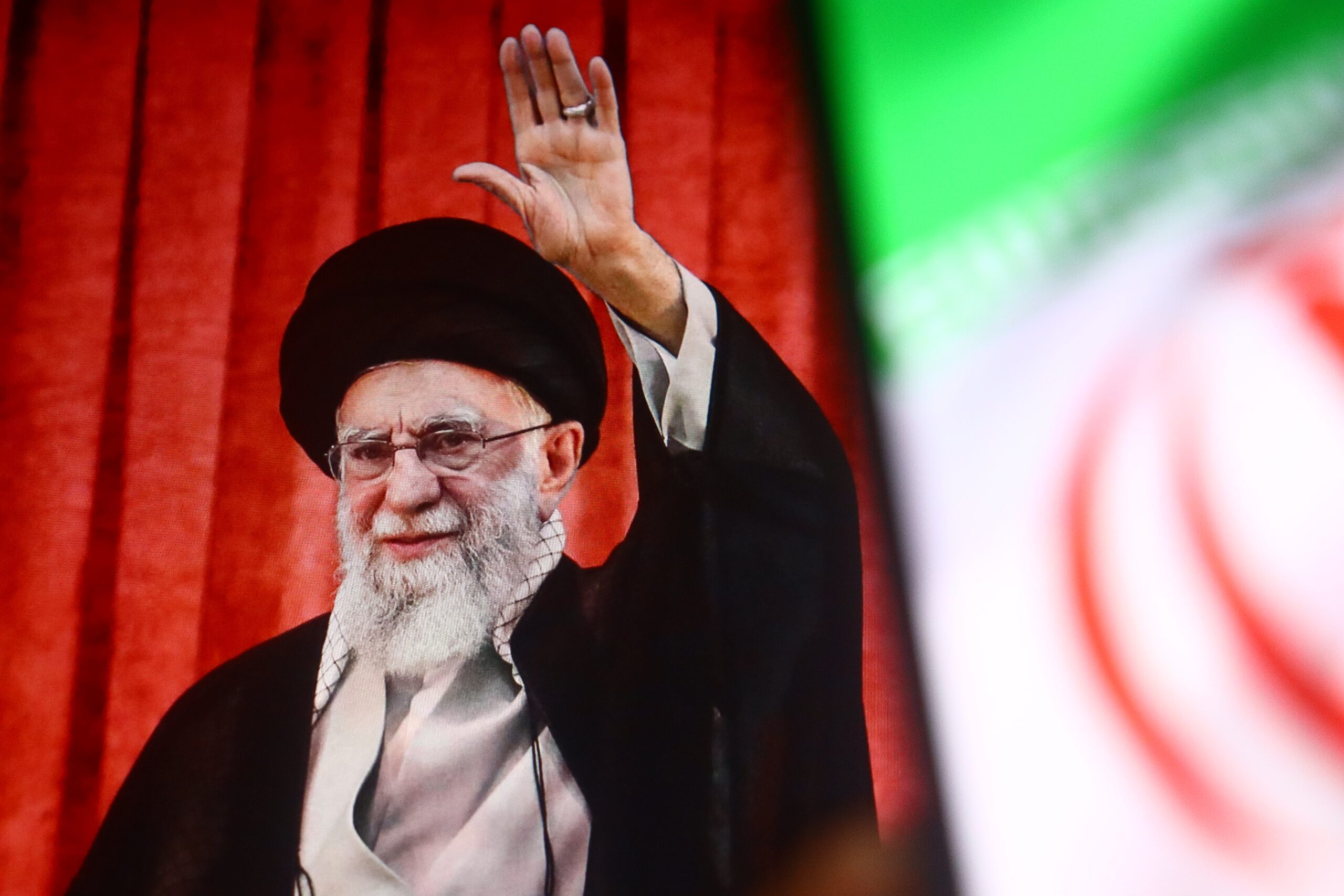
The Islamic Republic faces its gravest crisis in decades as mass protests sweep across Iran’s cities, leaving at least 35 dead and over 1,200 detained. While demonstrators fill the streets demanding freedom, intelligence reports reveal that Supreme Leader Ayatollah Ali Khamenei has prepared an escape plan to Russia, complete with a handpicked entourage of family and aides. The 86-year-old cleric’s contingency planning comes as Israeli Prime Minister Benjamin Netanyahu and U.S. President Donald Trump have reportedly reached understandings that include potential military strikes on Iran’s nuclear facilities if Tehran refuses to meet their demands.
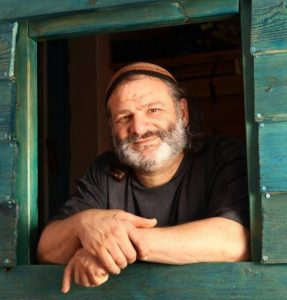
According to The Times, Khamenei’s “plan B” involves fleeing Iran with approximately 20 relatives and aides, including his son Ayatollah Mojtaba Khamenei, his chosen successor. Former Israeli intelligence officer Beni Sabti confirmed that Moscow remains the only viable destination for the Shi’ite cleric, noting Khamenei’s admiration for Russian President Vladimir Putin. If the plan materializes, Khamenei would become the second Russian ally in just over a year forced to seek sanctuary in Moscow, following Syrian President Bashar al-Assad’s December 2024 flight from Damascus.
A video circulating on social media shows the start of gunfire at protesters in the western city of Malekshahi, Ilam province, on Saturday. Information shared with Iran International indicates at least five people were killed and around 30 wounded during the incident. pic.twitter.com/spHJMhhLRv
— Iran International English (@IranIntl_En) January 4, 2026
Intelligence sources cited in the report indicate that Khamenei’s inner circle has already charted “an exit route out of Tehran should they feel the need to escape” and are “gathering assets, properties abroad and cash to facilitate their safe passage.” The contingency planning reveals the regime’s assessment of its own fragility as demonstrations spread across 250 locations in 27 of Iran’s 31 provinces.
The situation in Tehran now echoes the words of the prophet Daniel when he interpreted King Belshazzar’s vision, declaring a message that echoes through history: “God has numbered the days of your kingdom and brought it to an end; you have been weighed in the balances and found wanting; your kingdom is divided and given to the Medes and Persians” (Daniel 5:26-28). The writing appears on the wall for the Islamic Republic. Just as the Babylonian Empire fell in a single night when its people turned against it, so too does Iran’s theocratic regime face judgment from its own citizens.
The protests, now in their tenth day, have created a moment Netanyahu described as potentially transformative. “The government of Israel, the State of Israel, and my policy, we identify with the struggle of the Iranian people, with their aspirations for freedom, liberty, and justice,” Netanyahu told his cabinet Sunday. “It is very possible that we are standing at the moment when the Iranian people are taking their fate into their own hands.”
Tenth day of anti-establishment protests in Iran
— Ghoncheh Habibiazad | غنچه (@GhonchehAzad) January 6, 2026
Video shows a group of protesters dispersed in Tehran
Location: https://t.co/aG1KGN8UE2pic.twitter.com/Hz0oeqng9o
The Iranian people’s uprising occurs against the backdrop of economic devastation. The rial lost roughly half its value against the dollar in 2025, while official inflation reached 42.5% in December. The combination of economic collapse and political repression has created conditions ripe for regime change.
Trump has made clear his support for the Iranian people and his willingness to act against the regime’s brutality. Speaking to reporters on Air Force One Sunday, the president warned that Iran will “get hit very hard by the US” if it continues killing demonstrators. The State Department reinforced the message with a Farsi-language post on X declaring Trump “a man of action” and warning Tehran not to “mess with President Trump.”
The Iranian people have responded to Trump’s support with remarkable displays of solidarity. Protesters have spray-painted pro-Trump graffiti across multiple cities, with messages expressing hope that the American president will help liberate them from the regime’s grip. In one striking act of defiance, demonstrators renamed a street after Trump, directly challenging the Islamic Republic’s authority to control even the symbolic landscape of Iranian cities. These gestures reveal the depth of desperation among Iranians who see Trump not as a foreign leader but as a potential liberator. The appeals to Trump represent a stark repudiation of the regime’s four-decade narrative that America remains Iran’s greatest enemy.
Tenth day of anti-establishment protests in Iran
— Ghoncheh Habibiazad | غنچه (@GhonchehAzad) January 6, 2026
Viral photo shows protesters sitting in front of security forces in Tehran’s Grand Bazaar.
Location: https://t.co/oIdxft8vwC@GeoConfirmed pic.twitter.com/zVlXNcbPtf
According to a report in the Lebanese newspaper Al-Akhbar, cited by Israel Hayom, Netanyahu and Trump reached broad understandings during their recent meeting that extend beyond words of support. Senior international sources and Western embassies in Beirut indicate the two leaders agreed on three central tracks: a readiness to launch military strikes against Iran if it refuses conditions, including a complete halt to its nuclear program and an end to support for regional proxy forces, advancing the next phase of fighting in Gaza, and maintaining Lebanese neutrality as long as Hezbollah refrains from intervention.
Trump reinforced his position on Iran’s nuclear program, stating he would “absolutely” back renewed Israeli strikes on Iran’s missile and nuclear facilities if Tehran attempts to rebuild them. The president’s unequivocal stance marks a departure from previous administrations’ approach of diplomatic engagement without credible military threat.
The Al-Akhbar report claims that U.S. officials believe Iran’s acceptance of such terms would avert a strike and could lead to a broader settlement in Lebanon. Conversely, an attack on Iran or regime collapse would directly weaken Hezbollah due to its dependence on Tehran. The concept of Lebanese “neutrality” remains explicitly conditional. Any Hezbollah involvement in confrontation would trigger a wide Israeli response targeting the terrorist organization’s strongholds in Beirut’s Dahiyeh neighborhood and the Bekaa Valley in eastern Lebanon.
Regional dynamics add pressure on Iran. Saudi Arabia has intensified diplomatic efforts to push Tehran toward agreement with the West, driven by fears that war or internal chaos could spill into the Gulf. Riyadh worries that regime collapse could push Iran into a destabilizing role as a self-appointed “policeman of the Gulf,” according to sources cited in the report.
Massive crowds of Iranian anti-regime protesters have taken to the streets of Sonqor and Kolyai in Iran's Kermanshah province, joining the nationwide protests against the Islamic Regime. pic.twitter.com/8RC1OAdspL
— Visegrád 24 (@visegrad24) January 5, 2026
The Iranian regime’s response to the protests has been characteristically brutal. The semiofficial Fars news agency, believed to be close to Iran’s Revolutionary Guard, reported that 250 police officers and 45 members of the Guard’s all-volunteer Basij force have been injured in the demonstrations. The US-based Human Rights Activists News Agency, which relies on an activist network inside Iran and has proven accurate in past unrest, reports that the death toll includes 29 protesters, four children, and two security force members.
Netanyahu also addressed the dramatic weekend arrest of Venezuelan President Nicolás Maduro by U.S. forces in Caracas. “I want to express the entire government’s support for the determined decision and action of the United States to restore freedom and justice to that part of the world as well,” Netanyahu said. He noted that across Latin America, “several countries are returning to the American axis and, not surprisingly, to a connection with the State of Israel.”
Regarding Gaza, Netanyahu emphasized Trump’s unwavering position on Hamas disarmament. “He was unequivocal,” Netanyahu said of their meeting. “He repeated this both in our private conversations and to public opinion at the press conference there. He said it: ‘The essential condition is that Hamas disarms.’ There is no other option. This is an essential and fundamental condition for the implementation of his 20-point plan. He made no concessions and showed no flexibility on this issue.”
The convergence of internal Iranian uprising, economic collapse, international pressure, and credible military threat from Israel and the United States creates conditions unprecedented in the Islamic Republic’s 46-year history. Khamenei’s escape planning suggests even the regime’s leadership recognizes the potential for complete system failure.
The Sages taught that when a nation’s time has come, no force can preserve it. Iran’s theocratic regime, built on suppression of its own people and exportation of terror across the region, faces the reckoning it has long deserved. The Iranian people deserve freedom. The question is no longer whether change will come, but whether it arrives through internal collapse, external pressure, or military action. Khamenei’s packed bags suggest he knows the answer.
