




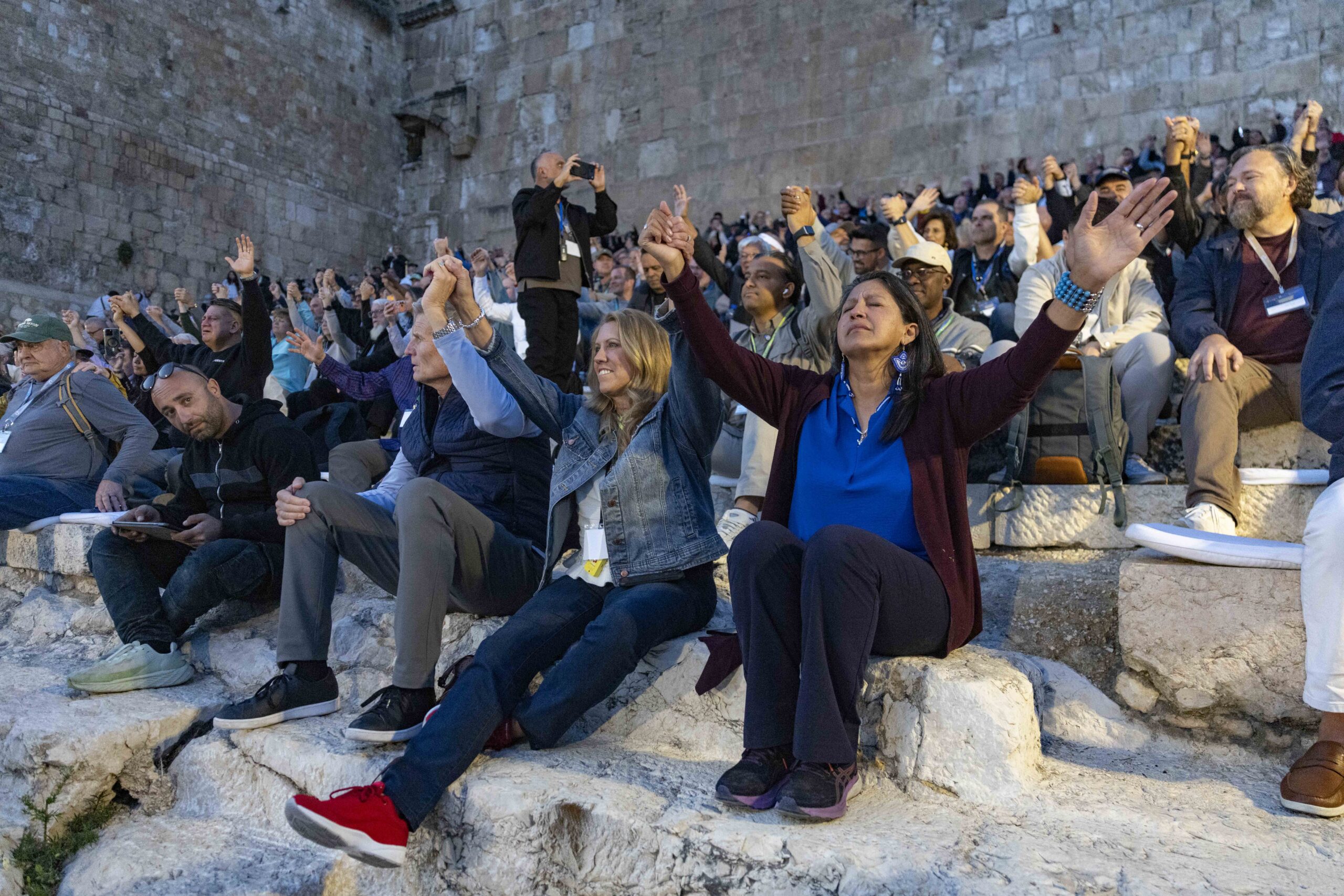
Last week, during a visit to the United States, Prime Minister Benjamin Netanyahu addressed a gathering of Christian leaders and delivered remarks that received far less attention than they deserved.
Speaking candidly, Netanyahu described a global ideological struggle against what he called the Judeo-Christian tradition, waged by radical Shi’ite Islam led by Iran, and radical Sunni Islam driven by the Muslim Brotherhood and its affiliates, with state and financial backing led by Qatar and Turkey. He spoke explicitly about the persecution of Christians across the Middle East, Africa, and beyond – and stated plainly that only one country in the region consistently protects Christian communities and allows them to thrive: Israel.
These comments were not sentimental, nor were they rhetorical flourishes aimed at a sympathetic audience. Netanyahu’s carefully chosen words – he was reading prepared remarks – contextualized Israel’s commitment to protect Christians in long-term geostrategic terms.
To fully appreciate what the PM was saying, his words must be taken alongside his recent remarks at the trilateral summit with Greece and Cyprus. At the close of his remarks there, he described Jerusalem, Athens, and Nicosia as the foundations of Western civilization – ancient peoples rooted in ancestral homelands, repeatedly conquered by empires, yet ultimately restored through sovereignty, sacrifice, and self-defense.
That shared history includes a decisive civilizational rupture: the 7th-century Muslim conquest of the Levant. This was not merely a change of rulers. It represented a direct challenge to the Judeo-Christian civilization that emerged between Athens and Jerusalem, what we now call the West. When Netanyahu warned that those who “fantasize” about reestablishing empires and dominion over these lands should “forget it,” he was not speaking abstractly. The message was aimed squarely at one man: the dictator of Turkey, Recep Tayyip Erdogan.
Erdogan’s neo-Ottoman ambitions and regional influence
Erodogan has made no secret of his ambitions. He openly invokes Ottoman imperial imagery, speaks of the conquest of Jerusalem as his goal, and presents himself as the patron of Islamist movements across the region. Under his leadership, Turkey has become the political sponsor and host of Hamas, a base for Muslim Brotherhood leadership, and a persistent antagonist of Israel, Greece, and Cyprus in the Eastern Mediterranean. Ankara has illegally occupied 37% of Cyprus for 50 years. From Libya to Syria to the Horn of Africa, Erdogan seeks to project Islamist influence under the banner of neo-Ottoman revival.
This context is essential to understanding Israel’s recent actions – and its emphasis on the persecution of Christians. Consider Somalia. Today, it is not only a failed state plagued by al-Shabaab terrorism; it is also one of the most dangerous places on earth to be a Christian. According to research by Open Doors International, Somalia ranks second globally – behind only North Korea – in the severity of Christian persecution. Christians there face execution if discovered, total prohibition of churches, violent enforcement of Sharia law, and death for conversion, often carried out by jihadist groups or even family members.
Somalia is not an anomaly. On the Open Doors World Watch List, nine of the 13 countries where Christians suffer the most extreme category of persecution are Muslim-majority states. Slaughter of Christians is not a deviance in these countries: It is a systemic feature of jihadist Islamist rule.
Here, Erdogan’s regional posture becomes unmistakable. Turkey champions Somalia’s internationally recognized Islamist-aligned government while refusing to recognize Somaliland – a stable, tolerant, democratic, pro-Western polity that resists jihadist control. Somalia fits Erdogan’s ideological worldview; Somaliland does not.
Israel’s recent decision to recognize Somaliland over the objections of Turkey, Qatar, and Somalia was far more than a technical diplomatic move. It was a direct challenge to Islamist monopolies over legitimacy in the Horn of Africa. Israel was declaring that despotic Islamist regimes do not get to decide which states deserve recognition – and that Somaliland’s resistance to jihadist ideology ought to be rewarded, not punished.
This brings us back to Netanyahu’s pledge to protect persecuted Christians. Israel is not doing so merely out of moral imperative, compelling as the case may be, but as a strategic imperative.
Just days ago, on New Year’s Eve, Islamist terrorists carried out coordinated massacres in Christian villages across Nigeria’s Adamawa, Kebbi, and Plateau states, killing at least 32 people, displacing hundreds, and destroying entire communities. According to regional monitoring groups, such attacks occur with regularity, even if Western media ignore these frequent October 7-style attacks.

In Syria, Israel has already acted – quietly but decisively – to protect Christian and Druze minorities threatened by Sunni-jihadist militias aligned with the A-Sharaa regime. Jerusalem understands what too many Western leaders still refuse to admit: Jihadist Islam cannot be accommodated, but must be confronted and defeated.
This is why Israel’s current posture matters. It is no longer behaving as a besieged state focused solely on its own borders: It is acting as a power confronting a global ideological threat. Defending Christians, protecting minorities, recognizing Somaliland, and standing shoulder-to-shoulder with Greece and Cyprus are not isolated gestures. They are elements of a coherent civilizational strategy.
An emerging superpower does not merely survive; it drives history. After October 7, Israel has learned that it cannot secure its future by defending borders alone. It must win the civilizational war globally to survive as a nation long-term. As long as jihadist ideology flourishes cannot be accommodated – from Gaza to Lebanon to Syria to Somalia – Israel will remain in the crosshairs.
So when Netanyahu tells would-be empire builders to “forget it,” he is not posturing. He is stating a strategic reality: Jerusalem is not Constantinople, the Eastern Mediterranean is not Ottoman territory, and Israel will not accept a region dominated by jihadist neo-imperial fantasies.
That is not the language of isolation: It is the language of resolve. The civilizational values that shaped the West were born in Jerusalem more than 3,000 years ago, and Israel is now stepping forward to defend them – freedom of religion, the protection of minorities, and human dignity – with strength.
The writer is the executive director of Israel365 Action and co-host of the Shoulder to Shoulder podcast.
This article was originally published on Jpost.com and shared with us by the author


