




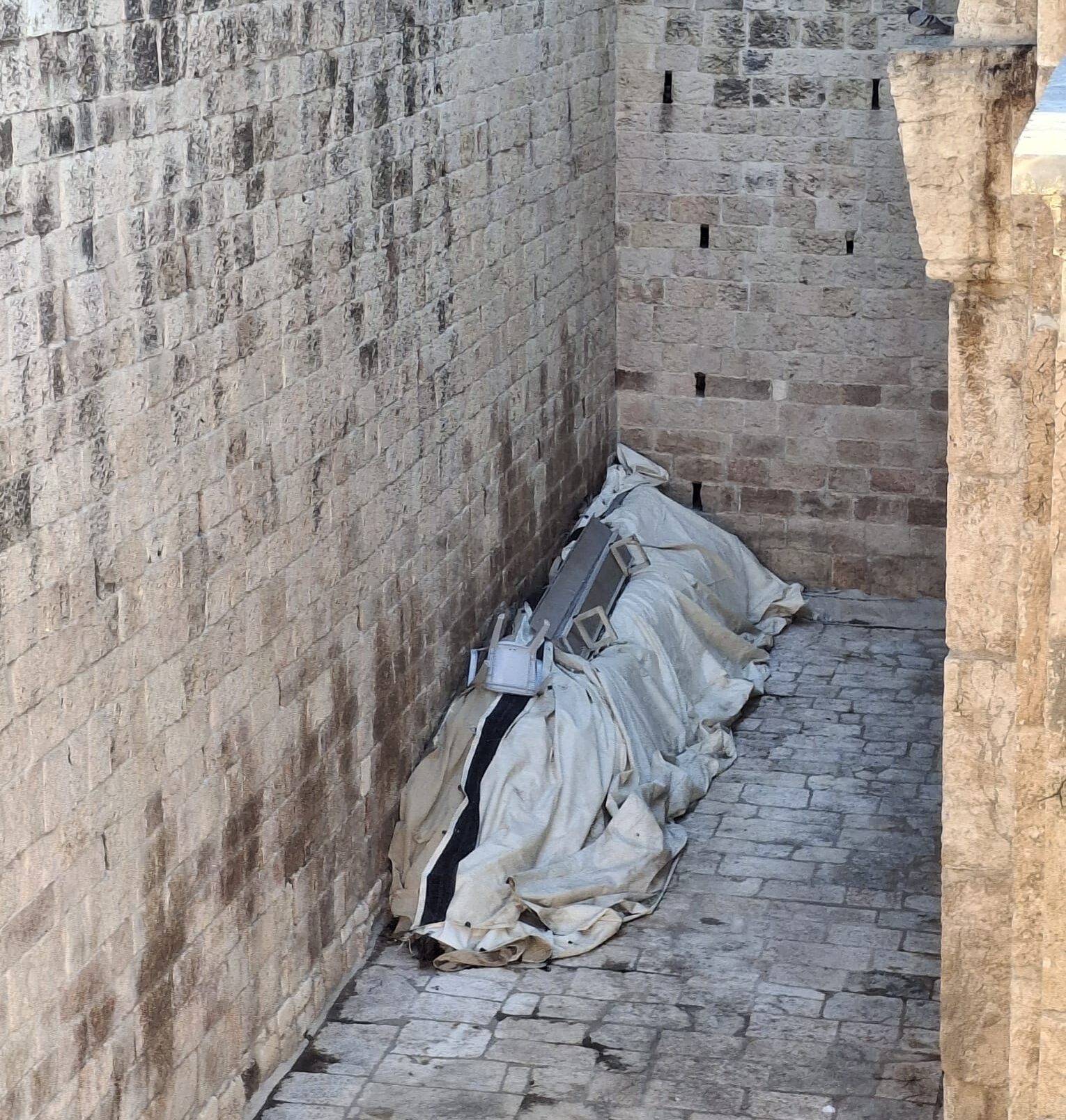
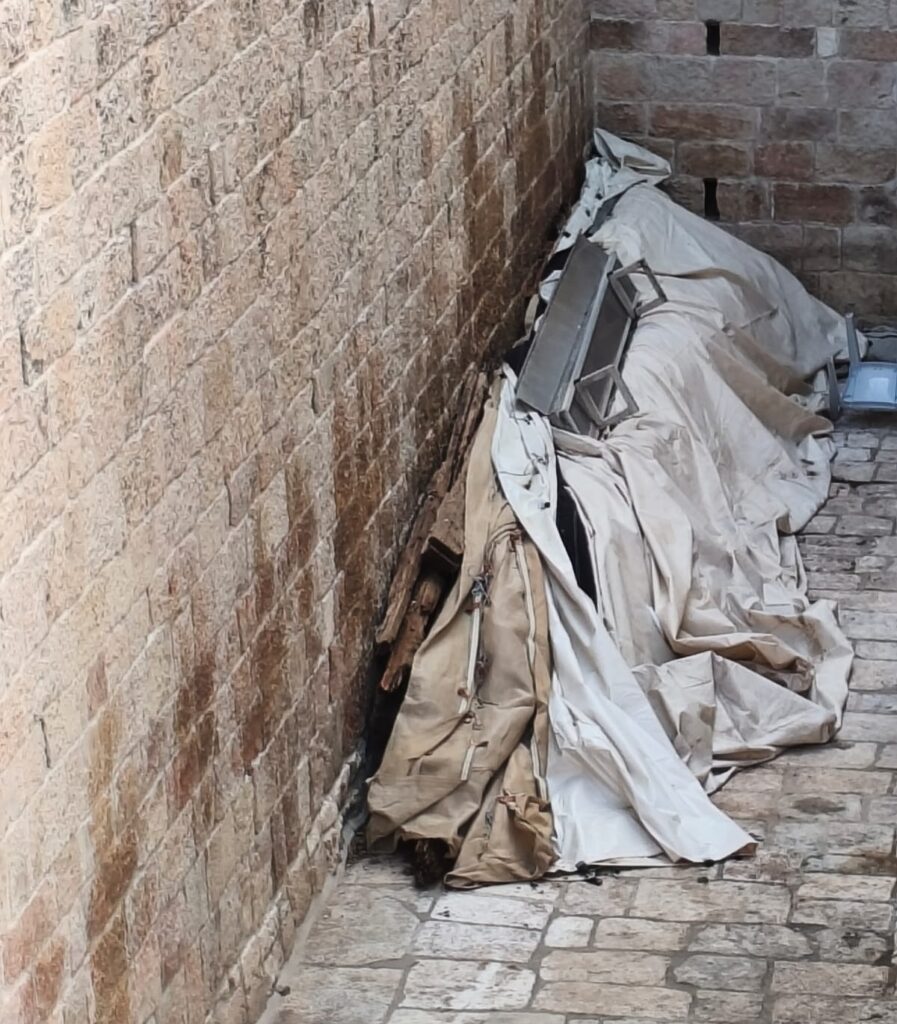
Wooden beams that once stood in Solomon’s Temple—timbers that witnessed the glory of the First Temple and survived its destruction—now lie exposed to the elements on the Temple Mount, covered only by a tattered blue tarp and surrounded by garbage.
The Beyadenu movement, which works to preserve Jewish heritage on the Temple Mount, recently discovered that protective coverings had been removed from these ancient beams near the Sha’ar HaRachamim (Gate of Mercy), also known as the Golden Gate. After activists reported the exposure, Beyadenu submitted an urgent request to the Israel Antiquities Authority to ensure the beams were re-covered before winter rains could inflict further damage. The Authority confirmed that the beams—many of which are identified as rare Lebanese cedar—have since been covered.
These are not replicas or reconstructions. Carbon-14 testing confirms that some of these oak beams are 2,860 years old, cut down around 880 BCE during the early First Temple period. One cypress beam dates to 630 BCE, just fifty years before Nebuchadnezzar razed the Temple to the ground.
The Sages teach us that the Temple Mount’s sanctity endures even in destruction. The Talmud states, “Even though the Temple was destroyed, its holiness was not destroyed” (Megillah 28a). Yet the Waqf, which exercises day-to-day control over the Mount, has systematically damaged and destroyed Temple artifacts in an attempt to obscure the historical and Biblical connection between the Jewish people and their holiest site.
These beams tell a story the Waqf would prefer remained buried. After the 1927 earthquake caused extensive damage to the Al-Aqsa Mosque, causing it to collapse, the structural roofing beams were dismantled and examined. Robert W. Hamilton, director of antiquities for the British Mandate, studied the beams at the Waqf’s request. He identified most as being from the early Islamic Umayyad Dynasty in the Eighth Century. The best examples went to the Rockefeller Museum near Jerusalem, where they remain on display.
The others were stored underneath the Temple Mount in Solomon’s Stables. When that area was converted into the Marwani Mosque in 1996, the beams were moved, and many disappeared. The leftovers ended up in the outer courtyard next to the Golden Gate. Some beams were sold to an Armenian wood merchant as scrap. Others became firewood. Some found their way to the town of Ofra in Samaria, where they were stored.
In the 1970s, Israeli botanists examined the beams and determined that most were cedars from Lebanon, and some were Cyprus trees. Carbon-14 testing revealed the truth the Waqf wanted hidden: these were not Islamic beams repurposed from earlier Islamic structures. The cypress beam, dated to 2,600 years old, was harvested around 630 BCE—approximately 1,400 years before the Al-Aqsa Mosque was built and some 1,200 years before Mohammad lived. The oak beam, dated to 2,860 years old, was cut down around 880 BCE, during King Solomon’s reign or shortly thereafter.
Archaeologists determined that these beams were used in Al-Aqsa as secondary materials. When the mosque was first built, the builders used materials that were on site from the destroyed Jewish Temples. The mosque literally stands on the remains of Jewish sovereignty.
The Bible records Solomon’s construction of the First Temple: “And King Solomon sent and brought Hiram out of Tyre. He was the son of a widow of the tribe of Naphtali, and his father was a man of Tyre, a worker in bronze; and he was filled with wisdom and understanding and skill to do any work in bronze. And he came to King Solomon and did all his work” (1 Kings 7:13-14). These beams are physical witnesses to that Biblical account.
Akiva Ariel, acting director of Beyadenu, stated, “The fact that physical remains from the days of King Solomon or the era of Herod are left outdoors and exposed to the elements is a national disgrace. While we commend the Antiquities Authority for its swift response ahead of the rains, we will not rest until these beams are transferred for professional preservation in a museum. The heritage of the Jewish people at their holiest site must never be taken for granted.”
A decade ago, the Israeli Antiquities Authority attempted to preserve the beams, but the Waqf insisted they were their property. There have been unconfirmed sightings of some beams stored next to the Golden Gate being burned.
The destruction of Temple artifacts continues a pattern. The Waqf has conducted illegal excavations on the Mount, dumping tons of archaeologically rich soil as garbage. They have converted ancient underground structures into mosques. They have blocked Jewish access and Jewish prayer. The exposed beams are not an accident or oversight—they represent contempt for Jewish history and an active campaign to destroy evidence of Jewish presence.
These timbers stood in Solomon’s Temple when Isaiah prophesied, when the Ark of the Covenant rested in the Holy of Holies, and when the Kohanim (priests) performed the service. They survived the Babylonian destruction, were incorporated into later structures, and have outlasted empires. They deserve better than to rot under a blue tarp, surrounded by refuse, on the Mount where they once formed part of the House of God.
The Israeli government must act. These beams belong in climate-controlled preservation, studied by scholars, displayed for the Jewish people and the world to witness. Every day they remain exposed accelerates their decay and erases another piece of evidence that the Temple Mount is, was, and always will be the holiest site in Judaism. The stone blocks of the Western Wall cry out in memory of the Temple. So too do these wooden beams—if we have ears to hear them before they are silenced forever.
Beyadenu has run several campaigns to preserve the Temple Mount and seeks public support for this mission. They request that concerned individuals sign an online petition. Concerned individuals can help Beyadenu by donating online.
