



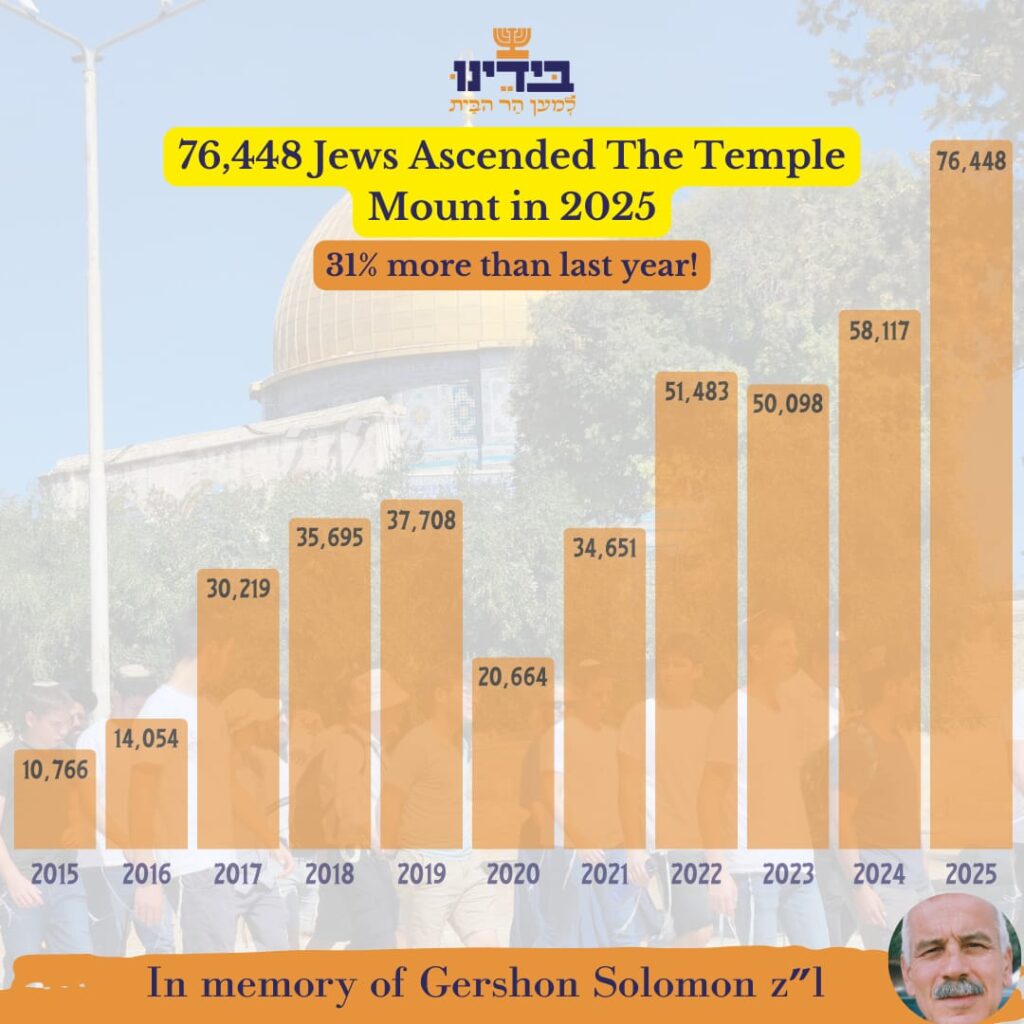
In 2025, 76,448 Jews ascended to the Temple Mount—Judaism’s holiest site—shattering all previous records. This represents a 31% increase over 2024 and marks the continuation of a decade-long surge that has seen Jewish presence at the site more than sevenfold since 2015, when only 10,700 Jews made the ascent.
The transformation extends beyond mere statistics. What was once the practice of a small, dedicated group has become a movement spanning Israeli society. In 2025, more than 30 educational institutions—from high schools to pre-military preparatory programs—brought students to the Temple Mount. Fifteen of these visits were coordinated through Beyadenu, the organization advocating for Jewish rights at the site, while additional institutions requested lectures and educational programming on the subject.
Jews from every background—ultra-Orthodox to entirely secular—are reconnecting with the place where two Temples once stood, where Abraham bound Isaac, where Solomon built his sanctuary, and where Jewish sovereignty was centered for a thousand years.
God chose this specific location as the dwelling place of His presence among the Jewish people. When King Solomon dedicated the First Temple, he declared: “But will God in very truth dwell on the earth? Behold, heaven and the heavens of heavens cannot contain You; how much less this house that I have built!” (I Kings 8:27). Yet despite the paradox, this mountaintop in Jerusalem became the focal point of Jewish worship, the destination of pilgrimage three times annually, and the direction toward which Jews pray no matter where they live on earth.
The Sages teach that the Temple Mount is the foundation stone of creation—even shetiyah in Hebrew—the spot from which the world itself was formed. When the prophet Isaiah envisioned the messianic era, he saw the nations streaming to this mountain: “And it shall come to pass in the end of days, that the mountain of the Lord’s house shall be established as the top of the mountains, and shall be exalted above the hills; and all nations shall flow unto it” (Isaiah 2:2).
During 2025, Jews openly used siddurim—Jewish prayer books—on the Temple Mount, reclaiming their right to worship at the site where their ancestors brought offerings and sang psalms.
The Israeli government, however, continues to impose severe restrictions on Jewish religious expression at the site. During 2025, 202 Jews received administrative bans from the Temple Mount following prayer or suspicion of prayer—compared to 109 in 2024, 85 in 2023, and 52 in 2022. The number of detentions and arrests remained high, with 468 Jews detained or arrested on the Temple Mount in 2025, compared to 497 in 2024, 317 in 2023, and 141 in 2022. The majority of cases stemmed from the ongoing denial of Jewish religious freedom at Judaism’s holiest site.
These restrictions date back to 1967, when Israel reunified Jerusalem. Despite liberating the Temple Mount after 2,000 years of exile, Israeli authorities—led by then-Defense Minister Moshe Dayan—granted the Islamic Waqf (religious trust) administrative control over the site. Israeli police enforce a policy that permits Muslims to pray freely while prohibiting any visible Jewish prayer. Jews who move their lips in prayer, bow, or display religious texts face immediate removal, detention, and often lengthy bans from the site.
The policy rests on the claim that Jewish prayer at the Temple Mount creates a security risk. Yet the steadily increasing numbers demonstrate that Jews will not be deterred from their holiest site, regardless of the obstacles placed before them.
Akiva Ariel, Acting CEO and Head of Public Affairs at Beyadenu, stated: “Nearly 80,000 Jews ascending the Temple Mount in a single year is a clear expression of a historic shift. The people of Israel are returning to the Temple Mount in practice. At the same time, the growing number of bans and arrests is a serious warning sign. The State of Israel must stop infringing on fundamental rights, ensure full freedom of worship, and officially recognize the Temple Mount as the holiest site of the Jewish people.”
The data reveals an undeniable trajectory. The Jewish people are reclaiming their connection to the Temple Mount, and no amount of bureaucratic restriction will reverse this movement. The site where God promised to dwell among His people is drawing the descendants of Abraham, Isaac, and Jacob back to their spiritual center. The question is no longer whether Jews will return to the Temple Mount, but when Israeli authorities will stop penalizing them for doing so.
