



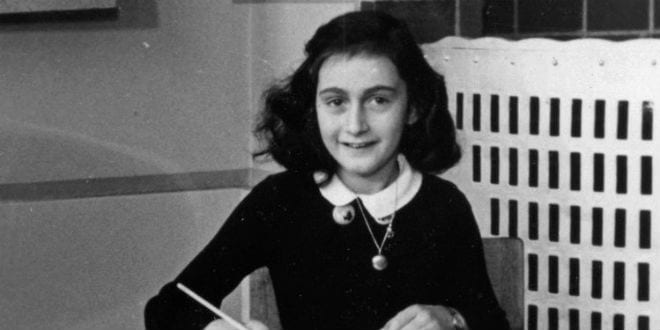
A painting now displayed at the Fluxus+ Museum in Potsdam, Germany, depicts Anne Frank—the Jewish girl murdered by the Nazis whose diary became the most widely read testimony of the Holocaust—wearing a Palestinian keffiyeh and writing on a tablet. The work, created by Italian artist Costantino Ciervo as part of an exhibition titled “Commune – The Paradox of Imagination in the Middle East Conflict,” has ignited fierce condemnation from Jewish organizations, the Israeli Embassy in Germany, and German officials who recognize it for what it is: a grotesque distortion of history that crosses the line from political commentary into antisemitic propaganda.
This manipulation of Anne Frank’s image is not merely offensive—it is a form of Holocaust denial. The International Holocaust Remembrance Alliance’s working definition of antisemitism explicitly includes “drawing comparisons of contemporary Israeli policy to that of the Nazis.” By placing a keffiyeh on Anne Frank, Ciervo and the museum curators who chose to display his work are making a deliberate statement: that Israelis have become the new Nazis, and Palestinians are the new Jews. This inversion is not art criticism or political commentary. It is historical falsification designed to delegitimize the Jewish state by equating it with the regime that murdered six million Jews.
The Israeli Embassy in Germany correctly identified this work as part of “a growing artistic trend” that exploits artistic freedom to normalize “historical distortion, antisemitism and, ultimately, terrorism.” Volker Beck, chairman of the German-Israeli Friendship Association, filed a criminal complaint against the exhibition’s curators, stating plainly what should be obvious to anyone with moral clarity: “It suggests Israel is doing to Palestinians what the Nazis did to Anne Frank.” Kai Diekmann, president of the Friends of Yad Vashem in Berlin and former editor of the Bild newspaper, called the painting “a clear distortion of the Holocaust and is nothing less than cynical falsification of history.”
Anne Frank was murdered because she was Jewish. The Nazis did not ask her about borders, settlements, or political positions. They murdered her because of what she was, not because of what she believed or what policies her future state might adopt. The Holocaust was the systematic annihilation of the Jewish people based on race. To compare Israel’s defensive military operations against Hamas terrorists—who openly call for the destruction of Israel and the murder of Jews worldwide—to the Nazi genocide is to trivialize the Holocaust, deny its unique historical character, and slander the Jewish state.
The Bible speaks clearly about those who call evil good and good evil: “Woe unto them that call evil good, and good evil; that put darkness for light, and light for darkness; that put bitter for sweet, and sweet for bitter!” (Isaiah 5:20). The prophet Isaiah condemned those who deliberately invert moral reality, and his words resonate today. To transform Anne Frank from a victim of antisemitic genocide into a symbol of Palestinian nationalism is to call evil good and good evil. It is to take the darkness of the Holocaust and recast it as a metaphor for Israel’s right to defend itself. It is to take the bitter reality of Jewish suffering and make it sweet for those who wish to see Israel destroyed.
A work by Italian artist Constantino Cervo depicts Anne Frank wearing a keffiyeh.
— Eli Afriat 🇮🇱🎗 (@EliAfriatISR) December 22, 2025
The Israeli embassy and Jewish organizations are demanding the work be removed, claiming it compares Israel to the Nazis and harms the memory of the Holocaust.
On the other hand, the artist and… pic.twitter.com/hMyMl7YnMY
The artist Ciervo claims his work is “about Israeli actions, not Judaism,” and insists he “strongly rejects” accusations of antisemitism. This defense is standard fare for those who traffic in antisemitic imagery while hiding behind the shield of political criticism. Museum director Tamás Blaneschy similarly insisted there is “no place, and never will be a place, for antisemitism” at his institution, yet he refuses to remove the painting. These denials mean nothing when the work itself does the speaking. When you appropriate the image of the Holocaust’s most famous victim and dress her in the symbols of Israel’s enemies, you are not making a nuanced point about policy. You are engaging in blood libel.
Anne Frank died at Bergen-Belsen in 1945, three years before the modern State of Israel was reestablished. She never lived to see the Jewish people return to sovereignty in their ancestral homeland. She never witnessed the fulfillment of the biblical promise that the Jewish people would return from exile: “And I will bring again the captivity of my people of Israel, and they shall build the waste cities, and inhabit them; and they shall plant vineyards, and drink the wine thereof; they shall also make gardens, and eat the fruit of them. And I will plant them upon their land, and they shall no more be pulled up out of their land which I have given them, saith the LORD thy God” (Amos 9:14-15). To use her image to attack the Jewish state is to deny her the very thing the Nazis tried to take from her people: a homeland where Jews can live and defend themselves.
Holocaust denial takes many forms. It is not only the crude claim that the gas chambers never existed. It is also the sophisticated argument that the Holocaust has been “exploited” by Jews for political gain. It is the insidious suggestion that Israel’s existence is a form of revenge against innocent Palestinians. And it is the artistic statement that places a keffiyeh on Anne Frank, suggesting that Jews have learned nothing from their suffering except how to inflict it on others. All of these are variations on the same theme: the Holocaust happened, but Jews have forfeited the moral authority they gained from it.
Those who stand silent while Anne Frank’s memory is desecrated, while her image is hijacked for propaganda, while her suffering is weaponized against the Jewish people—they bear responsibility for allowing this desecration to continue. The painting remains on display. The museum refuses to remove it. German authorities have yet to act decisively. This is how historical memory dies: not all at once, but piece by piece, through the cowardice of those who know better but do nothing.
Anne Frank wrote in her diary, hidden in an attic in Amsterdam as the Nazis hunted for her family, that she still believed people were good at heart. She was murdered for being Jewish. Today, her image is exploited to attack the Jewish state. There is no ambiguity here, no room for nuanced debate about artistic freedom. This is Holocaust denial dressed up as social commentary, and it must be called exactly what it is.
