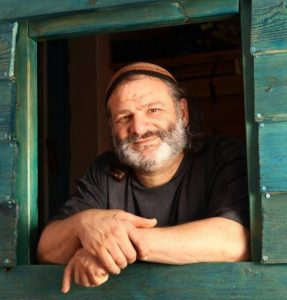
I recently returned home to Israel after a trip through Texas, Tennessee and Ohio. As I waited to deplane from my American Airlines flight in Newark, there was that usual crush of humanity—people standing up, wanting to leave, waiting in line for everybody to get their luggage.
But then it happened. A middle-aged and unhappy looking guy next to me began muttering nasty antisemitic comments about me. “Pushy Jew. Always pushy, always trying to get ahead. The Jew can’t wait his turn. No patience, no manners.”
Everybody was stuck. Everybody was standing there in the same situation, but he was, of course, singling me out because I was wearing my kippah, openly identifiable as a Jew. I resisted the urge to engage and kept telling myself “Elie, don’t make a scene. Don’t get arrested. You need to get home to Israel!”
Standing there in that aisle, I realized that I had been on edge for the entire trip. Walking through airports, sitting in restaurants, checking into hotels—always aware of my kippah, always scanning faces, always wondering what people were thinking. Would someone say something? Would there be a look, a comment, worse? Every identifiable Jew outside of Israel lives with this constant awareness.
Then I stepped onto my El Al flight home from Newark to Tel Aviv. The chaos hit me immediately—children crying, people praying in the aisles—all the usual craziness of an El Al flight. Yet I felt overwhelmed with relief. Not because I was physically safer, but because I was done calculating, scanning faces and measuring reactions. Here I was, surrounded by my people, no longer wondering who despised me or what they were thinking.
Then came the slaughter in Sydney.
Almost immediately, the familiar conversation began. Israelis said, “Come home to Israel, this is where Jews belong, where Jews are safe.” And the sarcastic replies came just as quickly: “Yeah, sure. Israel is the safest place for Jews. What about October 7? The terror attacks and intifadas?”
🚨 WATCH: This is Mamdani’s NY. An antisemitic attack involving a group of Jews from Canada returning from a Hanukkah event in Manhattan: a father and son attacked the young men on the subway, beat them, and cursed them for being Jewish pic.twitter.com/oUEVFSac7R
— Raylan Givens (@JewishWarrior13) December 16, 2025
By the numbers, statistically, they’re right. It is more dangerous to live in Israel than in many places around the world. If your primary goal is safety, then yes: it’s probably better to take off your kippah and spend the rest of your life on a beach in Thailand or in southern Italy.
A Jew can downplay his Jewishness—hide it, speak another language, change his name, his clothing, his customs—and live a quiet, peaceful life in most cities around the world. Those who argue for this are technically right. If personal comfort is the highest value, there are easier paths to it than living in Israel.
They’re right—and yet they’re missing the deeper point.
There is no other country on earth—and it’s doubtful there ever was—where you can live openly as a Jew and be proud of it the way you can in Israel. Yes, our sense of security here is mixed with a great deal of fear. Israelis can be tense and edgy, a result of years of war and terror. But it’s a different kind of fear: a fear of readiness. A “let’s see who dares mess with us” kind of fear that produces constant adrenaline.
Jews around the world can feel relatively safe only as long as they pretend not to be who they are. As long as they don’t openly attend Jewish events, keep the Star of David tucked inside the shirt, wear a sufficiently generic hat, and speak with a neutral accent. It’s true that this year, fewer Jews were murdered in London, Paris, or Berlin than in Jerusalem. Does that mean those cities are safer for Jews? Does anyone seriously believe that France or England are handling the Islamic threat within their borders better than Israel is?
In Sydney, Jewish families gathered at Archer Park near Bondi Beach for “Chanukah by the Sea”—a public celebration, a menorah lighting, a declaration that Jews are proud and we’re not hiding. Two gunmen opened fire from an elevated position overlooking the gathering. They had all the time in the world to shoot more than a hundred rounds into the crowd, leaving fifteen dead, including a child and a Holocaust survivor.
When Jews in Sydney gathered to light the Chanukah menorah, they were making a statement: we will not hide. We will celebrate publicly. We are here. And they paid for that pride with their blood.
The attack lasted ten long minutes—minutes in which people were hunted and fled for their lives, until finally a righteous non-Jew tackled one of the terrorists. In Israel, very few attacks in city centers last more than a minute. In most cases, the terrorist is neutralized almost immediately—sometimes with bare hands, sometimes with sticks and stones.
Over the past decade, European countries have stationed armed guards at synagogue entrances. A few months ago in Venice, I tried to attend Friday evening prayers at a synagogue in the Jewish Ghetto. An armed Italian guard interrogated me at the entrance—not because he cared about my safety, but because the Italian government decided Jews are a security risk that needs managing. I was a potential problem to be screened, not a citizen to be protected.
Today, an antisemite walked up to a Jewish home in one of London’s most Jewish areas, pulled out a knife, and tore the mezuzah off the door.
— Dov Forman (@DovForman) May 20, 2025
Still think this is “just about Israel”?
Once again in Europe, Jews are being attacked at our homes and pushed to the margins of society. pic.twitter.com/isjNKOHcKa
In other words, that guard wasn’t there for me. He was there for them—to prevent a Jewish problem from becoming an Italian problem. In Israel, the armed guard at a synagogue is Jewish. He’s protecting his own people, in his own country. He answers to us, not to them.
That’s not a minor distinction. It’s everything
There are fears in Israel too—but here, we are the guards. The story of the State of Israel is the story of a people who understood that it could no longer rely on the goodwill of other nations, and instead created its own defense forces. Even though the state failed catastrophically on October 7, it is still the only country that sent 300,000 people into action to guarantee Jewish existence and to destroy the infrastructure from which a pogrom had emerged.
The question isn’t whether there are dangers in Israel. Of course there are. The question is: where can a Jew walk down the street wearing a kippah without calculating the risks? Where can we light a menorah in public and know that if—God forbid—something happens, there will be armed and trained Jews who will respond within seconds, not minutes?
But Israel is the only place in the world where a Jew can live openly and proudly as a Jew, knowing that if danger comes, other Jews will respond—immediately, forcefully, without hesitation. That readiness to fight for one another exists nowhere else on earth.
The choice isn’t between safety and danger. The choice is between living as Jews—fully, openly, proudly—or living as Jews in hiding, always looking over our shoulder, always wondering who in the crowd hates us.
Israel is our answer to that choice.