



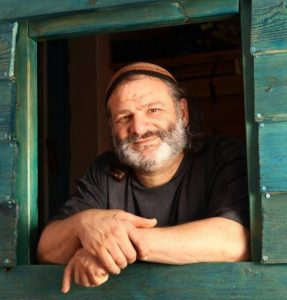
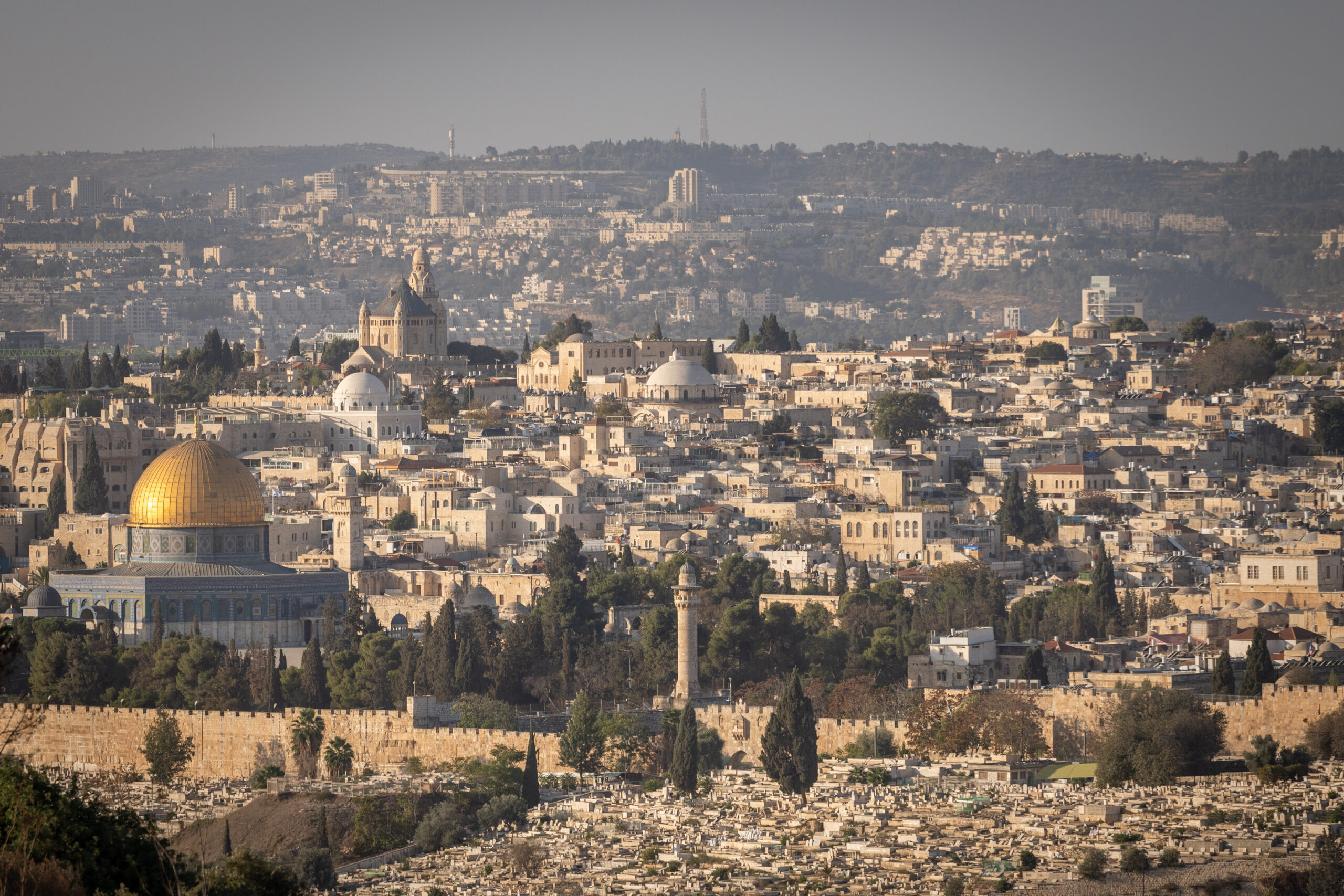
A group of Levites gathered at Judaism’s holiest site on Monday, the first day of Hanukkah, their voices rising in a passage from the holiday liturgy that resonated across the ancient stones. They sang in memory of victims of the horrific terror attack in Sydney and in solidarity with the Jewish community of Australia. One of the Levites came from Bondi itself, the Sydney neighborhood where the attack occurred.
The Levites sang the final verse of Maoz Tzur, a song traditionally recited while lighting Hanukkah candles. The choice carried particular weight—a message of strength and Jewish unity stretching from Jerusalem to the Jewish diaspora at a moment when both communities face ongoing threats.
The Beyadenu movement for the Temple Mount facilitated the ascent as part of the organization’s ongoing efforts to strengthen the living, national connection to the site.
Maoz Tzur means “Rock of My Salvation” in Hebrew. Written in the 13th century CE, the song recounts the history of Jewish survival against successive empires that attempted to destroy the Jewish people. Each verse chronicles a different oppressor—Pharaoh’s Egypt, Babylonian exile, Persian persecution under Haman, and the Greek-Syrian forces under Antiochus, who defiled the Second Temple.
The final verse looks forward rather than backward. It calls for the defeat of Edom, a term the Sages use to represent Rome and, by extension, all forces that seek to harm Israel. The verse declares: “Reveal Yourself to him and let him see Your great power. Hasten the time and save us soon in our days.” This petition for divine intervention takes on urgent meaning in the wake of the October 7 massacre and the Sydney attack.
The Bible teaches about the Jewish people’s endurance: “The remnant of Jacob shall be in the midst of many peoples like dew from the Lord, like showers upon the grass, which tarrieth not for man, nor waiteth for the sons of men” (Micah 5:6). This passage speaks to a people that persists regardless of external threats, whose survival depends on divine providence rather than human goodwill.
The connection between Maoz Tzur and Hanukkah makes the Levites’ performance particularly fitting. Hanukkah commemorates the Maccabean victory over Greek-Syrian forces and the subsequent rededication of the Second Temple in 164 BCE. The Greeks sought not merely to conquer Jewish territory but to eradicate Jewish practice and belief. When the Maccabees reclaimed the Temple, they found only enough ritually pure oil to light the menorah for one day. The oil burned for eight days—the miracle that Hanukkah celebrates. The Sages teach that this miracle demonstrated divine intervention when human resources proved insufficient.
Maoz Tzur accompanies the lighting of Hanukkah candles in Jewish homes worldwide. Its fourth verse praises the Hasmonean warriors who “broke down the walls of my towers” and restored proper worship in the Temple. By singing this song on the Temple Mount on the first day of Hanukkah, the Levites connected ancient liberation to contemporary resistance against those who would silence Jewish voices.
Akiva Ariel, acting CEO of Beyadenu, connected the performance to the holiday’s broader significance. “On Hanukkah, the festival of light and heroism, the song of the Levites on the Temple Mount takes on an especially deep meaning,” he said. “Even in painful and difficult moments, when we are attacked, the voice of the Jewish people will never be silenced, neither in the Land of Israel nor in the Diaspora.”
The Sydney attack struck a community already reeling from the October 7 massacre. Hamas terrorists killed 1,200 people and took hundreds hostage in coordinated assaults across southern Israel. Jewish communities worldwide remain on heightened alert. The Bondi neighborhood, home to a significant Jewish population, became another target in a pattern of violence directed at Jews regardless of location.
The presence of a Levite from Bondi at the Temple Mount performance made the solidarity tangible. A Jew who grew up in Australia now stood at Judaism’s holiest site, singing for his former neighbors who face violence in their own communities. The Sages teach based on Leviticus 26:37 that “all Israel are responsible for one another.” This principle establishes collective accountability among Jews worldwide. When one community suffers, all communities bear that burden.
The Temple Mount holds a unique status in Jewish tradition. It was the site of both the First and Second Temples. Jews worldwide pray facing Jerusalem, and more specifically, facing the Temple Mount. The Sages identified the site as the foundation stone of creation itself, the place where heaven and earth meet. Performing liturgy there carries weight that transcends ordinary prayer.
In the book of Chronicles, King David organizes the Levitical singers: “David and the commanders of the army set apart for the service the sons of Asaph, Heman, and Jeduthun, who prophesied with lyres, harps, and cymbals” (1 Chronicles 25:1). This was not ceremonial music. The Sages teach that Levitical song was an essential component of the Temple service itself, so integral that sacrifices offered without it were considered incomplete.
Traditionally, Temple musicians were selected from the tribe of Levi. The Zohar explains that the Levites were chosen to sing in the Temple because the name Levi means “to accompany,” and their music would draw others closer to God. In the days when the Temples stood in Jerusalem, the Levites sang on the 15 steps—corresponding to the 15 Songs of Ascent in Psalms 15—that led from the Ezrat Nashim (“Court of Women”) to the Ezrat Yisrael(“Court of Israelites”). The Mishna states that there were never fewer than 12 Levites standing on the platform, but their number could be increased indefinitely. While ordinarily, no minor was permitted to enter the Azarah (“Courtyard”) to take part in the service, the young Levites were allowed to join in the singing to “add sweetness to the sound” but were not permitted to stand on the same platform with the adult Levites (Talmud Erchin 2:6).
The Levites who sang on Monday stood in the footsteps of their ancestors who once filled the Temple courts with psalms. Their voices carried across stones that remember King David’s harp and Solomon’s dedication of the First Temple. The performance declared that the ancient service has not been forgotten, that the connection between the Jewish people and their holiest site remains unbroken despite nearly two thousand years of exile.
Beyadenu announced they are encouraging additional Levites to come forward and join the growing Levite community at the Temple Mount. The organization views the Levites’ presence as part of asserting Jewish connection to the site and maintaining the people’s relationship with their holiest location.
The choice to sing the final verse of Maoz Tzur rather than earlier verses was deliberate. The first verses recount past deliverances—victories already achieved. The final verse addresses present and future struggles. It expresses both the ongoing threats facing the Jewish people and confidence in ultimate victory. The Bible states: “For the Lord will not cast off forever, but though He causes grief, yet will He have compassion according to the multitude of His mercies” (Lamentations 3:31-32).
The timing amplified the message. Hanukkah represents victory against forces that sought to eradicate Jewish practice and identity. The Maccabees fought for the right to worship according to Jewish law. When they reclaimed the Temple, their first act was to purify it and rekindle the menorah. Maoz Tzur recounts this story, praising the Hasmoneans who restored proper worship. By singing this song at the Temple Mount on Hanukkah’s opening day, the Levites connected ancient liberation to contemporary defiance of those who would silence Jewish voices through terror.
Maoz Tzur has accompanied Jews through medieval persecution, pogroms, the Holocaust, and modern terrorism. Written in the 13th century CE, it has proven remarkably durable. Each generation finds its circumstances reflected in the song’s verses. The Sages teach that the Bible contains layers of meaning that reveal themselves according to the times. The same principle applies to liturgy—texts written centuries ago speak to present crises because human evil follows patterns and divine justice remains constant.
The performance on Monday was an act of defiance and faith. It declared that terror will not silence Jewish voices, that the Temple Mount remains central to Jewish identity, and that the ancient promise of deliverance holds. The terrorists who struck in Sydney and those who massacred on October 7 sought to break Jewish will. The Levites answered with music.

