



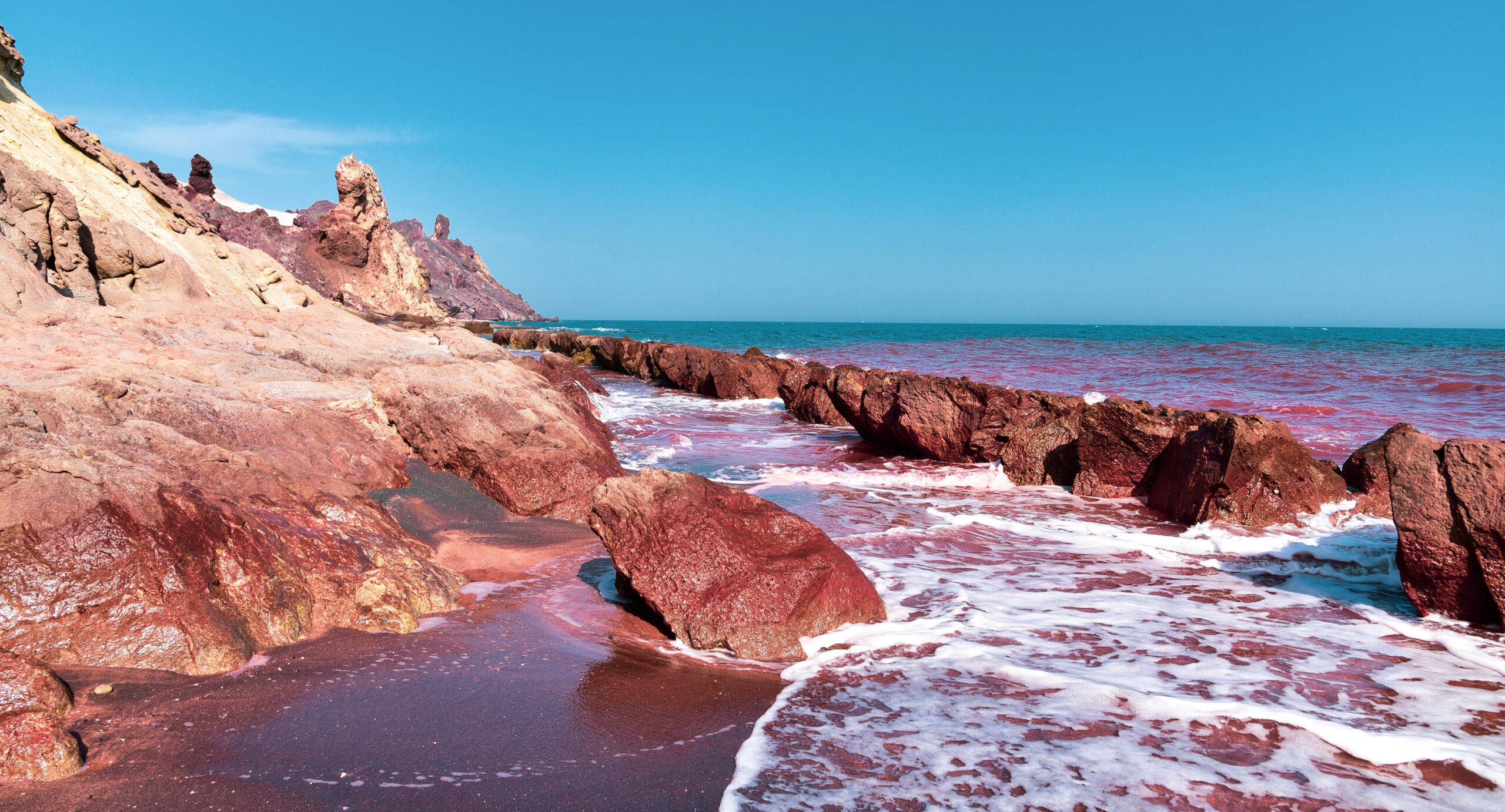
On Tuesday, rain-filled wadis turned blood red on Iran’s Hormuz Island, turning the usually blue Persian Gulf into a scene reminiscent of the first plague that led to the Exodus of the Jews from Egypt.
Rain turned a quiet Iranian island into a viral spectacle this week. On Hormuz Island, rainfall sent streams of iron-rich red soil cascading down cliffs and across the shoreline, tinting the shallow waters a deep crimson and briefly transforming the famous Red Beach into something that looked almost unreal. Images and video spread rapidly, but the phenomenon itself is neither mysterious nor unprecedented. It is an annual event tied to geology, weather, and a location that has mattered to empires for millennia.
Hormuz Island sits in the Strait of Hormuz, the narrow maritime chokepoint linking the Persian Gulf with the Gulf of Oman, roughly 1,080 kilometers south of Tehran. Rain is scarce on the arid island and falls mainly in winter and early spring. When it does, runoff carries fine particles of iron oxide from the island’s exposed hillsides into the sea. The soil, locally called gelak, is rich in hematite, the mineral that gives iron ore its red color. In powdered form, hematite reflects red wavelengths of light while absorbing blue and green, producing the striking blood-red tint when mixed with rainwater and seawater.
The island’s unusual chemistry developed over millions of years. Layers of shale, clay, volcanic rock, and more than seventy identified minerals are compressed into a small landmass. The red soil is not only photogenic. Limited quantities are exported for use in pigments, cosmetics, and traditional products. Tourism has grown around these landscapes, and each rainfall renews global attention on a place already central to modern geopolitics because of its position astride one of the world’s most critical shipping routes.
The Bible repeatedly uses water transformed into blood as a sign of judgment and upheaval, not as poetry but as a declaration that political power and natural order can be overturned in an instant. In the account of the plagues in Egypt, the text states, “And all the waters that were in the river were turned to blood. And the fish that were in the river died, and the river stank, and the Egyptians could not drink water from the river; and there was blood throughout all the land of Egypt” (Exodus 7:20–21). The verse is blunt and physical. It describes ecological collapse as a divine response to tyranny.
The Sages took this language seriously. They taught that when the Bible describes nature itself rebelling, it signals a moment when human arrogance has reached its limit. The transformation of water, the most basic element of life, marks the collapse of assumed permanence. In Jewish sources, such imagery is not about spectacle but about warning. Geography matters. Rivers, seas, and borders are not neutral backdrops; they are instruments through which history is directed.
From a Jewish perspective, the lesson is sharper and less speculative. The Bible insists that land and sea respond to moral reality. The Strait of Hormuz is not only a modern shipping lane or a flashpoint of international tension. It sits within a broader biblical map in which the rise and fall of nations is inseparable from the behavior of those who rule them. When water turns red, even briefly, it recalls a consistent biblical pattern: dominance is temporary, and nature itself bears witness when power is abused.
The Torah portion describing the Nile turning to blood (Exodus 6:2–9:35), known as Va’eira, will be read in six weeks.
Moshe and Aharon did just as Hashem commanded: he lifted up the rod and struck the water in the Nile in the sight of Pharaoh and his courtiers, and all the water in the Nile was turned into blood Exodus 7:20
The location is sparsely inhabited and miles from the Iranian mainland, known locally as Silver and Red Beach. It is no stranger to this annual phenomenon. The volcanic soil on the island contains a high iron oxide content, producing a reddish pigment called Golak by the natives. Golak is made into a reddish ochre used for artistic and culinary purposes.
Jewish sources predict that the ten plagues will reappear in the final Redemption, but in even more powerful forms. It is written in Midrash Tanchuma, homiletic teachings collected around the fifth century, that “just as God struck the Egyptians with 10 plagues, so too He will strike the enemies of the Jewish people at the time of the Redemption.”
Nahmanides, a prominent 12th-century Torah scholar from Spain, wrote in his commentary on the plagues that the primary reason God punished the Egyptians was not for enslaving the Israelite people but for dismissing God and his influence in their lives.
This concept was explained by Rabbi Bahya ben Asher, a 13th-century Spanish commentator, who wrote, “In Egypt, God used only part of His strength. When the final redemption comes, God will show much more of His power.”
Christian readers often view the region through the lens of later apocalyptic literature, particularly the idea that events east of the Euphrates signal an end-time alignment of powers. Without citing their texts, it is accurate to say that many Christian interpreters associate dramatic changes in Middle Eastern waters with divine judgment and military realignment. The focus is not on chemistry but on geography and timing, with Iran frequently placed in an eastern coalition in those readings.
Islamic tradition also assigns symbolic meaning to unusual natural signs, especially when they occur in historically charged locations. In Islamic eschatology, disturbances in nature are read as warnings preceding judgment, emphasizing divine control over creation and the fragility of human power. While the red waters of Hormuz are explained scientifically, their recurrence in a region central to Islamic history inevitably draws religious reflection among Muslim audiences as well.
The image of a blood-red river has strong connotations for the Biblically-minded but is also significant to Muslims. In Islam, there are five plagues, i.e., floods, locusts, lice, toads, and the turning of drinking water into blood. In comparison, in the Bible, there are ten plagues, i.e., water into blood, frogs, lice, wild animals, diseased livestock, boils, storms of fire, locusts, darkness, and death of the firstborn. According to the Koran, the plagues were brought by Moses (Musa), one of Islam’s five most prominent prophets.