




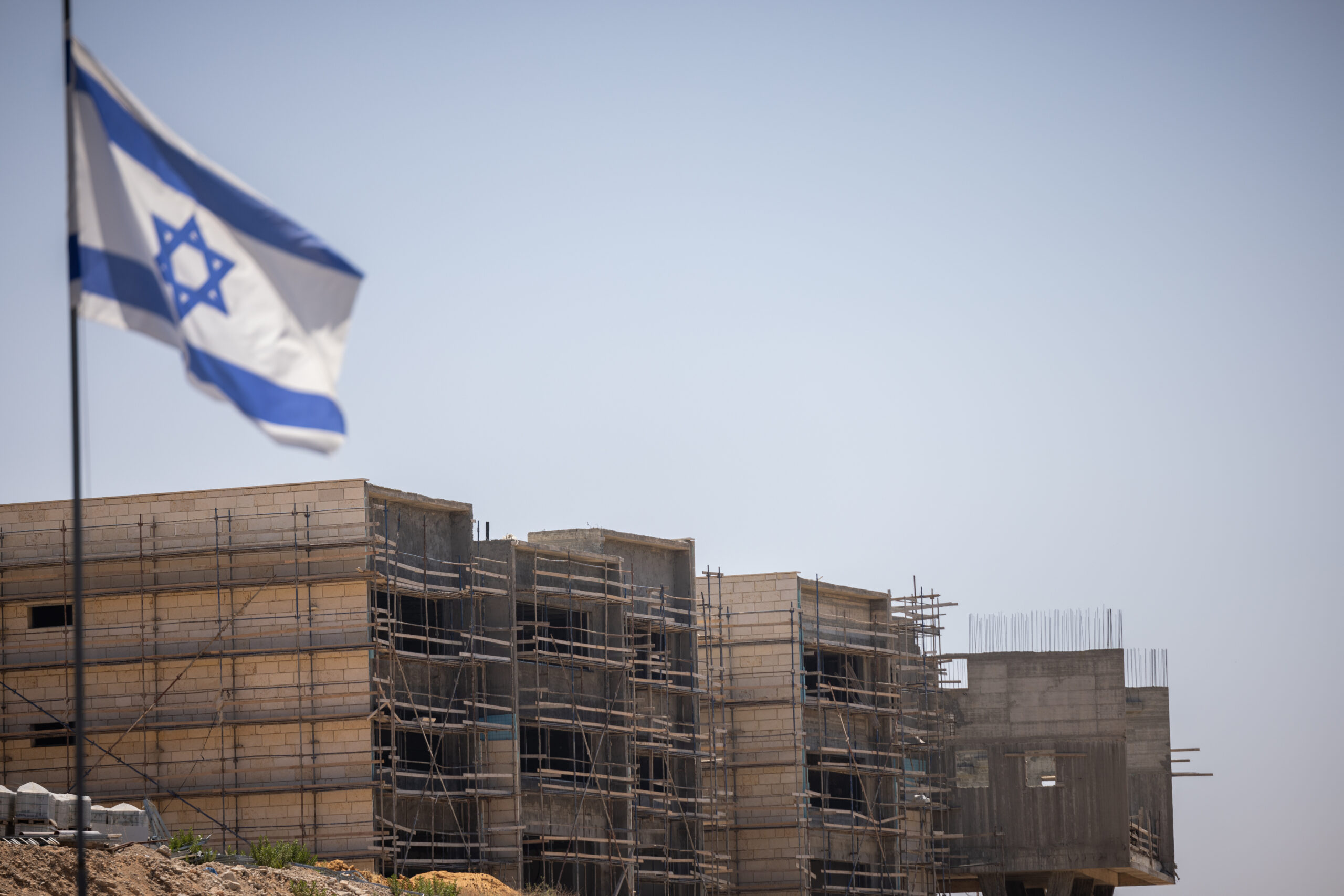
Israel’s decision to expand Jewish communities in Judea and Samaria moved forward again this week when the Higher Planning Council authorized 764 new homes in Hashmonaim, Beitar Illit, and Givat Ze’ev. The establishment of Israeli communities would permit Jews the right to live and move freely in Judea and Samaria, which is prohibited in areas controlled by the Palestinian Authority.
The announcement set off a predictable round of foreign criticism and a sharp condemnation from the Palestinian Authority, which claimed the move would “ignite the region.” Inside Israel, however, the approval reflects a steady acceleration of construction in areas the government sees as vital to the country’s security and future.
Israel’s announcement on Wednesday detailed the approvals: 478 new homes in Hashmonaim, 230 in Beitar Illit, and 56 in Givat Ze’ev. Smotrich said the move was part of “a clear strategic effort to strengthen settlement and ensure continuity of life, security, and growth.” His office noted that since he assumed responsibility for civilian affairs in Judea and Samaria, approvals for 51,370 housing units have been granted. For Smotrich, this trajectory is not a temporary push but a governing philosophy. “Israel is continuing the revolution,” he said, calling the expansion “Zionism in action” and emphasizing that planning is carried out “not with slogans but through orderly, consistent, and responsible work.”
Opposition to the decision came quickly from the Palestinian Authority. Nabil Abu Rudeineh, spokesperson for PA President Mahmoud Abbas, said the approvals “aim to ignite the region” and claimed they would “drag it into a cycle of violence and war.” He urged the Trump administration to pressure Israel to halt the construction, framing it as a threat to regional stability.
Inside Israel’s governing coalition, the response was the opposite. United Torah Judaism MK Meir Porush welcomed the authorization, saying the expansion of Beitar Illit was “good news for young couples and families living there.” For communities facing overcrowding and long waiting lists, the added housing represents immediate relief.
These developments unfold against the backdrop of longstanding territorial frameworks. Under the Oslo Accords of the 1990s, Judea and Samaria were divided into Areas A, B, and C. Area C, which includes all three locations approved this week, remains under full Israeli security and civilian control. In recent months, the government has accelerated activity in these zones, including Smotrich’s August approval of a major construction project in Ma’aleh Adumim’s E1 corridor and the Knesset’s preliminary approval in October of the “Application of Israeli Sovereignty in Judea and Samaria, 2025” bill.
President Donald Trump’s posture toward Israeli sovereignty in Judea and Samaria has been complex and evolving in the months since he took office. On the one hand, conservative members of the U.S. political establishment and pro-Israel voices in Washington have publicly urged him to recognize Israel’s right to extend sovereignty over the biblical heartland and to stop using the term “West Bank,” arguing that such recognition would affirm the region’s historic and religious significance to the Jewish people. Lawmakers in the Friends of Judea and Samaria caucus and allied evangelical leaders have pressed Trump to take a clear stand in support of Israeli sovereignty, framing it as consistent with both history and biblical connection to the land. Many of these voices emphasize that Judea and Samaria are central to Israel’s identity and security, and that U.S. policy should reflect that reality.
At the same time, Trump himself has stopped short of unequivocally endorsing an immediate sovereign extension by Israel. During a press interaction in early 2025, he indicated that the matter was under discussion and that an announcement might come, without committing to a definitive policy. In more recent reporting, Trump has signaled to foreign leaders that he would not permit formal annexation of the region, warning that such a step would jeopardize U.S.–Israeli cooperation. This duality reflects the administration’s balancing act: Trump’s broader foreign policy remains staunchly pro-Israel in many respects, yet in practice he has avoided publicly committing the U.S. to formal sovereignty declarations, at least for now.
For decades, US policy was based on a “land for peace” formula, first enshrined in the Oslo Accords of the 1990s. Its left-wing, typically secular/anti-religious advocates presented Oslo as a historic breakthrough with promises of coexistence, economic prosperity, and the gradual birth of a Palestinian state alongside Israel.
The tragically misnamed Two-State Solution would create an unprecedented militarized Arab state inside Israel’s borders, ethnically cleansed of Jews, with its capital in an exclusively Muslim Jerusalem. This would require a return to the ceasefire lines drawn up after the defensive 1967 Six-Day War that are considered to be indefensible against an Arab threat.
But for most Israelis, the reality of Oslo was not peace but bloodshed. Hamas and Islamic Jihad unleashed a wave of suicide bombings. Between 1993 and the early 2000s, more than 1,000 Israelis were murdered in terror attacks carried out by Palestinian factions emboldened by Israel’s territorial concessions. Instead of yielding peace, Oslo created a heavily armed Palestinian Authority in the West Bank and entrenched terror enclaves in Gaza. The forcible expulsion of Jews from Gaza in 2005, justified by its architects as a continuation of Oslo’s vision, only deepened the failure. Israel uprooted 21 thriving Jewish communities and withdrew from Gaza entirely. Within two years, Hamas seized control of the Strip, transforming it into a fortified terror base from which thousands of rockets and, ultimately, the October 7 massacre, were launched.
