



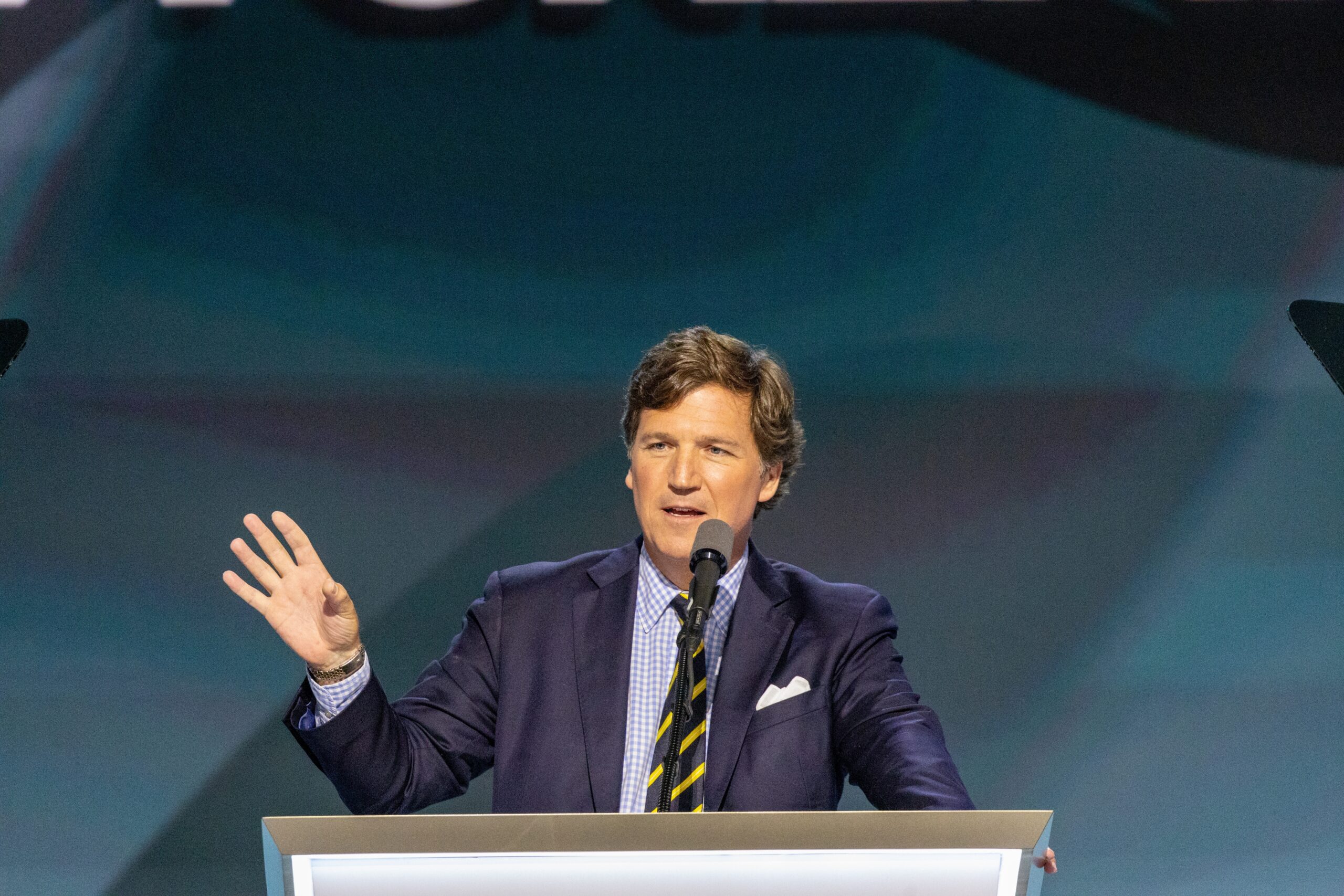
Tucker Carlson’s growing relationship with Qatar moved into an entirely new phase this weekend when he told an audience at the Doha Forum that he intends to buy a home in the Gulf emirate. The announcement came during his on-stage interview with Qatar’s prime minister, Sheikh Mohammed bin Abdulrahman bin Jassim Al Thani, and it immediately intensified an already fierce fight inside the pro-Trump, pro-Israel world over Qatar’s ties to Hamas and its long campaign to shape American media. Carlson framed the decision as admiration for Qatar’s role as a regional mediator. For critics inside the pro-Israel camp, the optics were unmistakable: a leading American conservative voice choosing to plant personal roots in a state that continues to host Hamas leadership and bankroll its operations in Gaza.
Laura Loomer, a Florida-based activist and close ally of President Donald Trump, was the first to publicize Carlson’s appearance at the Doha Forum, posting screenshots of his profile on the event’s website. She has spent months accusing Carlson of being aligned with Doha and undermining U.S. support for Israel. Her allegations escalated after reports—unverified but widely circulated—that Qatar paid for an earlier Carlson interview with the Qatari prime minister. Carlson and his business partner Neil Patel have categorically denied the claims. Still, the stage in Doha tells its own story: Carlson, Patel, and investor Omeed Malik appearing alongside Hillary Clinton, Donald Trump Jr., Christiane Amanpour, and senior Gulf officials, all under a banner of “Justice in Action.”
Carlson’s new declaration about buying property in Doha adds a level of permanence to a relationship that is already reshaping parts of right-wing media. His critics note his recent pattern of hosting guests who promote antisemitic narratives, including Holocaust deniers—content that Qatar’s media strategists have openly exploited. His supporters insist he is doing nothing more than interviewing world leaders. Loomer calls it capitulation. Senator Ted Cruz mocked the appearance online with the hashtag “#QatarFirst.” Within the pro-Israel world, the discomfort is sharp, especially after the October 7 massacre and the ongoing war with Hamas.
Carlson’s on-stage praise for Qatar’s “mediation efforts” came at the same time as reporting documenting how Qatar has invested heavily in shaping American conservative media. Filings under the Foreign Agents Registration Act show multimillion-dollar contracts with firms tasked with promoting Doha’s messaging in U.S. outlets. Conservative journalists repeatedly received suggested storylines from Qatari-funded lobbyists, followed days later by articles echoing those same talking points in Fox News, the New York Post, and the Daily Mail. One contract requires business-class travel on Qatar Airways and bars the firm from working with any other Middle Eastern government. Another paid $80,000 a month to a former Republican aide whose job was to soften conservative criticism of Qatar’s ties to Hamas and Iran.
Qatar’s influence does not stop at media. Its funding of American universities helped produce the wave of campus antisemitism that surged after October 7. Qatar’s Education City initiative and multi-billion-dollar gifts to U.S. institutions created ideological pipelines that treat Hamas as a legitimate “resistance movement” and present Israel as a colonial intruder. Those narratives appeared almost verbatim in the campus protests that erupted this year. The same government hosting Hamas leaders in five-star hotels was simultaneously shaping the environment in which American students chanted support for the terrorists who carried out the worst massacre of Jews since the Holocaust.
Carlson is not alone. A growing list of right-wing commentators and political figures have embraced appearances, interviews, or partnerships with Qatar. Some defend the emirate as a necessary U.S. partner. Others seem drawn to its messaging about “independent media” and “dialogue,” themes Doha has perfected while using its vast wealth to advance the interests of Hamas and the Muslim Brotherhood. For many Israelis, this trend looks less like engagement and more like a steady normalization of a government that shelters the architects of October 7.
When major voices in American conservative media align themselves with a state enabling terrorists who openly call for Israel’s destruction, the consequences are real. Qatar has invested heavily in shaping the stories Americans hear about Israel, Hamas, and the war. Now it is investing in the people who tell those stories.
Carlson’s decision to buy a home in Doha marks a turning point. It signals that Qatar’s influence operation has reached deeper into the American right than many realized. Israel’s supporters cannot afford to ignore this shift. Clarity is required, not compromise, especially when dealing with a government that funds terrorists and then sells itself as a mediator.