



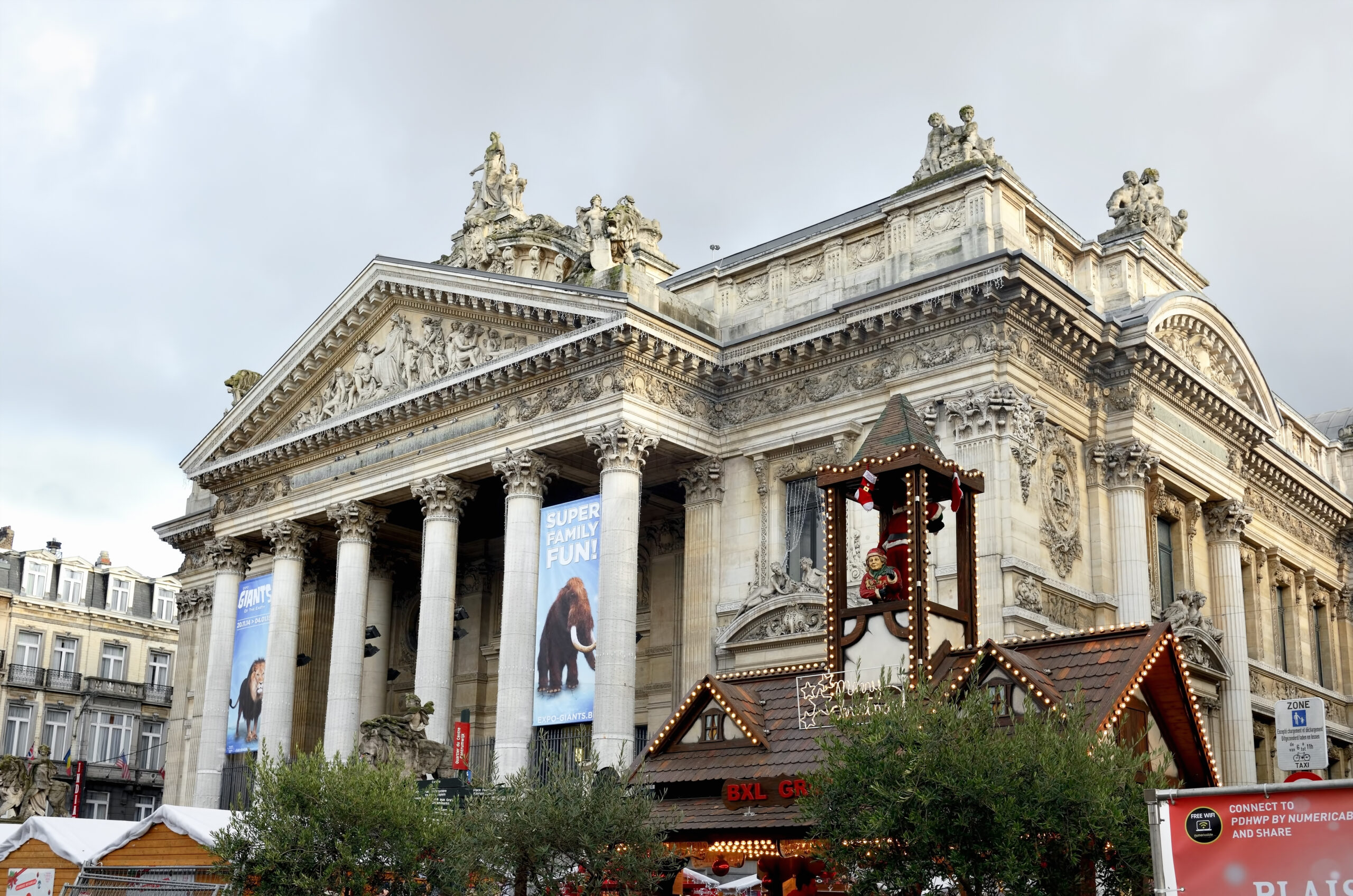
Brussels’ Winter Wonders market opened on Friday at the Place de la Bourse, drawing the usual crowds at the official start of the holiday season. The event was interrupted shortly after opening when pro-Palestinian protesters entered the market area, set off smoke bombs, and blocked several entrances. Footage posted online showed smoke drifting between the stalls while families moved away from the scene and vendors closed their booths. Police said the disturbance overlapped with the weekly Gaza demonstration that takes place every Friday at 6 p.m. in the same location.
Dutch political leader Geert Wilders criticized the protest on social media, calling it an example of what he described as “Islamisation.” He posted a video showing demonstrators marching through the Christmas market with torches, drums, and keffiyehs. Wilders wrote, “Christmas market in Brussels turns into an Islamic hell.”
“Elsewhere in Europe, Christmas markets are under extra surveillance,” Wilders said. “This is the result of decades of open borders. We must stop the Islamisation of the West. Freedom instead of terror. Islam does not belong here.”
🚨 JUST IN: In a terrifying sight, Muslims STORMED the opening night of the Christmas market in Brussels, waving Palestinian flags, setting off smoke bombs and scaring families.
— Eric Daugherty (@EricLDaugh) November 29, 2025
Coming to YOUR town if Islam is not exiled from the West.pic.twitter.com/zvP39k91LC
Belgian politicians also expressed concern. MP Sam Van Rooy of Vlaams Belang said the protest undermined public safety at a major holiday event. Bob De Brabandere, also of Vlaams Belang, condemned the demonstration, and N-VA MP Darya Safai called the participants “extremists.” Several asylum seekers from Gaza who had taken part in previous protests were later detained in return centers, according to Belgian authorities.
Organizations responding to the incident focused on the impact on families present during the disruption. Christian Women for Israel said that Christmas markets are places where people “gather under the banner of ‘peace on earth,’” adding that filling those spaces with smoke and shouting sends a message that “your joy is not safe, and your traditions are not respected.” The group stated that intimidation in family settings “does the opposite” of peaceful protest.
London faced a similar disturbance on Black Friday. Heavy shopper traffic on Oxford Street was halted when protesters carrying Palestinian flags entered the district, chanting “Shut it down for Palestine” and “Killing children is a crime.” Videos from the scene showed crowds pressed against storefronts as demonstrators used whistles, pounded on windows, and blocked traffic near major retailers, including Zara and Selfridges. The protest coincided with the International Day of Solidarity with the Palestinian People and formed part of coordinated marches across Europe on November 29.
Hundreds of pro-Palestinian protesters marched on Oxford Street, Regent Street and Carnaby Street on Saturday urging Christmas shoppers to boycott 'Israeli-linked' brands in Londonhttps://t.co/YbFP0hZSEg pic.twitter.com/wzHkEKEH4s
— Sky News (@SkyNews) December 24, 2023
European Christmas markets have maintained heightened security since the 2016 truck attack in Berlin. In recent years, several markets in Germany, France, and the Netherlands have faced disruptions linked to Muslim groups that targeted these gatherings during the holiday season. Authorities say these incidents have added pressure to events that traditionally serve as central public spaces during December.
The disruptions in Brussels and London show a trend that continues to shape Europe’s holiday period. Events built around family, tradition, and commerce are increasingly forced to operate under security concerns that were rare a decade ago. The pattern adds another layer to a season that once depended on predictability and now must contend with the possibility of politically charged interruptions.
